
A to Z of Welsh Art: J is for... Jones?
Names and Callings: A Common Patronym and the Courage to Diverge
“What’s in a name?” With that familiar line of enquiry opens an article “About the Joneses” in the August 1885 issue of The Red Dragon, an English-language periodical grandiosely self-designated as “The National Magazine of Wales.” Without naming the playwright credited with raising the question, the writer quipped that Shakespeare was “probably justified in his doubts so far as the rose is concerned”; but, had he lived as a Jones in our time, “he would have come to the conclusion that there is a good deal in a name, and, like many of the Joneses, have adopted a peculiar Christian name to distinguish himself” from the rest of them.
Whatever there might be in the name, there is at least a “good deal” of it. To this day, Jones is the most common surname in Wales. Then as now, however, most Joneses of note do not simply rely on an unmistakable first name, the bearing of which, to begin with, is generally not a matter of choice. In the crowded field of contemporary art, the Joneses are as prominent as they have long been in other walks of life. More than sixty of them are included in Jones and Hitchman’s Post-War to Post-Modern: A Dictionary of Artists in Wales (2015), in addition to the Johns and Johnsons that also number among the offspring of many a Ioan, following a patronymic tradition dating back to the days when surnames were as foreign to Wales as the letter J is to the Welsh language.
As can be readily demonstrated by surveying the representative Joneses in this or, indeed, any Rogers Jones auction—twentieth-century and present-day artists ranging from Jack to Mary Lloyd—sharing a common surname is no impediment to renown, given techniques and approaches as individualistic as theirs. Besides, many of them have faced challenges greater than the inheritance of a prevalent proper noun, not least because they chose to make a name for themselves in the arts.
Aneurin and Jack Jones
Finding a Calling
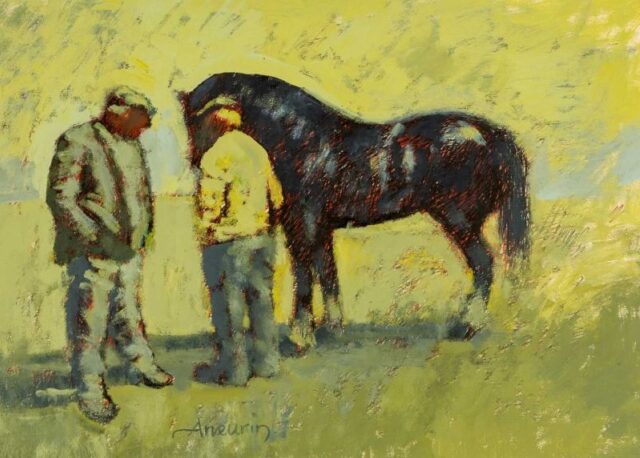
“The emphasis in the past has been almost entirely on the spoken and written word,” painter Aneurin Jones (1930–2017) has been quoted as observing as late as the 1980s, “and on this account some other elements of the nation’s culture have been neglected.” And while there has been “marked development and improvement over the years” as far as opportunities are concerned, he added, “what can be bettered is anything but good!” In view of such biases and disadvantages, life as a professional artist was rarely considered a first choice, much less pursued without a back-up plan.
Aneurin Jones mixed media - Welsh cob with two figures
The Welsh Sale (Part I), 22nd November 2026
£1,800-2,500
Before embarking on a career as a painter, Jack Jones (1922–1993) studied and taught English, in which language he published short stories, poems and, in his words, “slighter things” for newspapers as well as “dramatic stuff for broadcasting.” As a creative writer, Jack felt obliged to add the middle name “Raymond” to set himself apart from his older namesake, a prominent Welsh autobiographer, novelist and playwright.
In a Welsh context, Jack’s contributions to the visual arts are so singular as to require no such nominal effort, even though, as has often been noted, his signature style bears some resemblance to the work of L. S. Lowry. According to Jack the similarity was entirely coincidental. He was so much the outsider—largely self-taught and working on his Jack Jones, as it were—that, when he set out as a painter in the early 1950s, he was unaware of Lowry’s iconic “matchstick” figures, which had made their first appearance three decades earlier.
Jack Jones oil on board 'Capel Zion'
The Welsh Sale (Part I), 22nd November 2026
£2,000-3,000
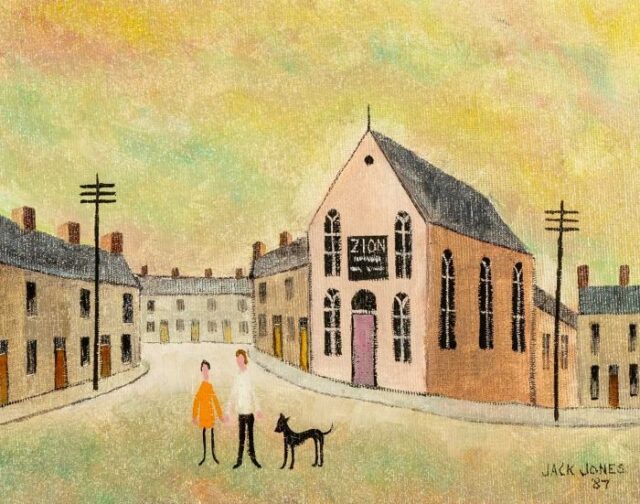
Serving as head of English at a London grammar school, Jack did not become a full-time artist until the mid-1970s. By that time his “naïve” approach to landscape art had matured, suggesting that his outsider position had been adopted and nurtured as advantageous. Rather than being an odd man out, Jack had created a niche for his paintings, which were featured in group exhibitions and solo shows in Swansea, Cardiff, and London from the 1960s onwards.
Far removed though they are from the landscapes and portraits of the industrial south of Wales that practitioners such as London-born painter-printmaker George Chapman (1908–1993) or Polish émigré artist Josef Herman (1911–2000) produced in the 1950s and ’60s, paintings such as Terrace of Houses, Pentrechwyth (1974) are nonetheless identifiably Welsh in subject matter, referencing, from an assumed child’s perspective, specified locations of Jack’s hometown, Swansea. And while representational fidelity is clearly not aimed at, his evocations of “home” are no less eloquent than they would be had realism served as a guiding principle in the rendering of topography and atmosphere.
Jack Jones oil on card - 'Terrace of Houses, Pentrechwyth'
The Welsh Sale (Part I), 22nd November 2026
£1,500-2,500
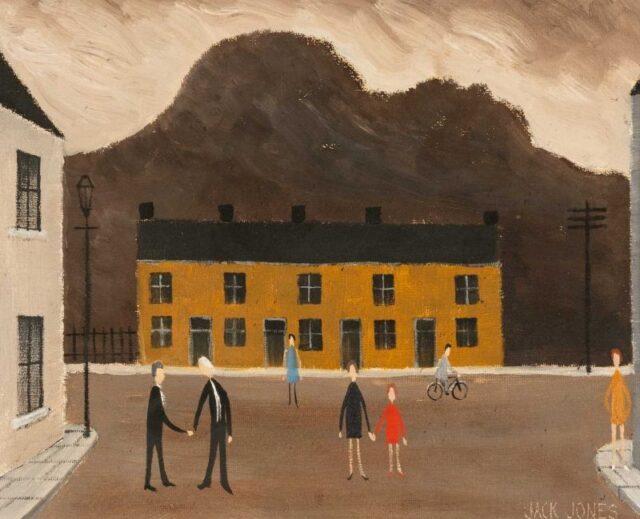
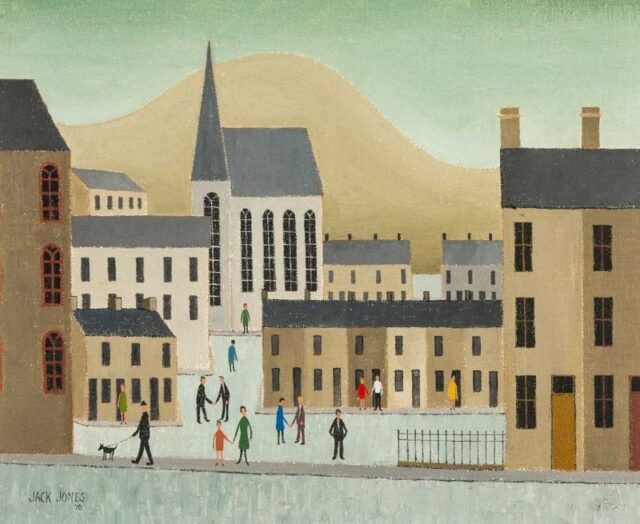
In his poem “Home,” published in December 1959, Jack calls to mind the “grey streets” that “snake a valley’s bed,” where houses stand like “regular soldiers, / Stiffly at attention” in terms that anticipate his later paintings and yet, like the staffage that enlivens his compositions, withhold much and, unlike the impenetrably abstract celebrations of self that dominated the Western artworld at the time, promise less.
Jack appreciated as “true” the sorrow in his downcast eyes as captured by his friend Kyffin Williams (1918-2006) in a 1969 portrait now in the collection of the National Library of Wales. By comparison, Jack’s uncomplicated and seemingly innocent townscapes grant no access to a troubled inner life. Keeping the bouts of depression with which he was afflicted hidden from view, Jack’s paintings are comforting by design, as delightful and smiling as the concluding lines of “Home”:
Terraced houses breath a song
In unison,
Hold hands in rows
Like daisy chains, or
Children playing games.
In dolls’ houses
Warmth is spread;
In the hearth
Is nourished
A little love,
While overhead
The roof of heaven
Arcs its way across the stars.
Jack Jones oil on panel 'St. Joseph's Church'
The Welsh Sale (Part I), 22nd November 2026
£3,000-6,000
Ray Howard-Jones
A Life in Colour and Light
Among Jack’s circle of acquaintances was Ray Howard-Jones (1903–1996), who herself identified as poet first and painter second. Determined to succeed, as she would, spectacularly so, in a male-dominated artworld, she strategically shortened her first name, Rosemary, to “Ray.”
Slyly playing the naming game, Ray would later exhibit alongside her partner, the photographer Raymond Morse, as one of “The Two Rays.” To her Welsh neighbours, who followed the tradition of conferring plain-talking sobriquets on each other, she was known simply as “Ray the Paint.”
Aptly chosen, “Ray” is reflective as well of her life-long fascination with colour and light, which had earned her the nickname “Sunbeam” in childhood. At the Slade School of Fine Art, where she began studying at the uncommonly young age of seventeen, Ray was deemed to be the “finest colourist” the institution had “ever produced.”
Ray Howard-Jones mixed media 'From Davidstone, The Island'
The Welsh Sale (Part I), 22nd November 2026
£300-500
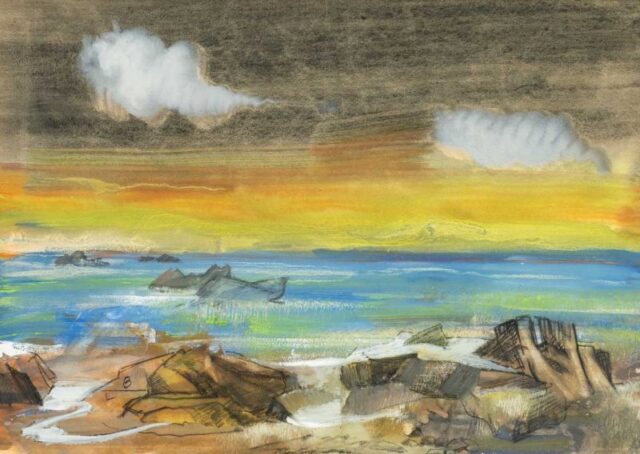
Auspicious though her beginnings were, Ray was held back by poor health, suffering early in life from extrapulmonary tuberculosis and sustaining injuries that made it painful for her even to hold a pencil. A mention of one of Ray’s London exhibitions in the February 1943 issue of Studio magazine alludes to “several years of crippling illness, during which the doctors despaired of saving her life.”
Ray refused to be defined by ill health. Hers was a long and active life, much of which was spent in nature. The dramatic scenery, wildlife and elementary forces along and off the Pembrokeshire coast—Marloes peninsula, Skomer as well as neighbouring islands such as Skokholm—absorbed her as both painter and poet:
Rock Pipits run, and hop the spray
Where napweed blackened by the heat
Lies scalloped to the sand.
And here, entwined,
Base to the treble rhythm of the laced tides leaving
Your footsteps pass,
One ... by ... one
And my bare toes, in threes to each of yours
Mark now the passing days
Ray Howard-Jones oil on board 'Skokholm Island'
The Welsh Sale (Part II), 23rd November 2026
£250-350
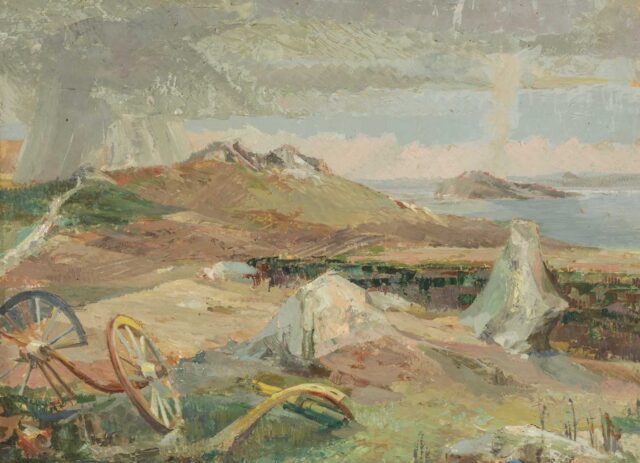
On the occasion of a 1974 retrospective, her friend and fellow artist-poet David Jones (1895–1974)—whose drawings are also in the current sale—remarked that Ray’s “milieu” was the “most westward extremity of Wales,” where lithosphere and watersphere and atmosphere merge with each other and this near off-shore insula or that small ynys out toward mid-channel come and go in the changing light—now sharply defined, now lost in a diaphane of mist-drift.
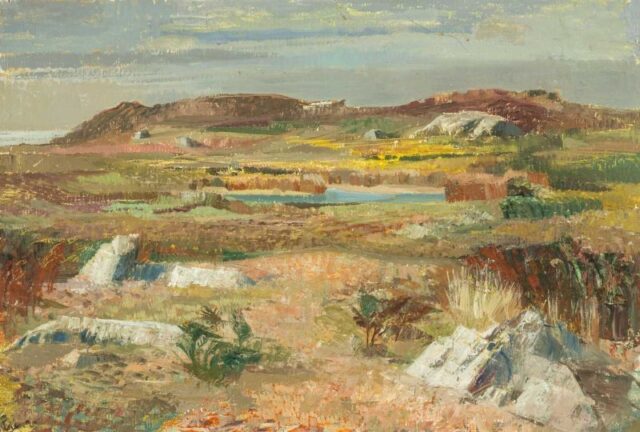
Beginning in 1949, and for a decade thereafter, Ray spent several months each year on Skomer, now a national nature reserve. Here, she produced the drawings that formed the basis for the compositions in oil and gouache she created in her London studio and, from the late 1950s onwards, exhibited regularly at the Leicester Galleries. She came to prefer the latter medium as it permits greater spontaneity that more closely corresponds with the temperamental sea and her intimate experience of it.
Ray Howard-Jones oil on card 'Skomer - The Main Pond, Island Pond'
The Welsh Sale (Part I), 22nd November 2026
£400-700
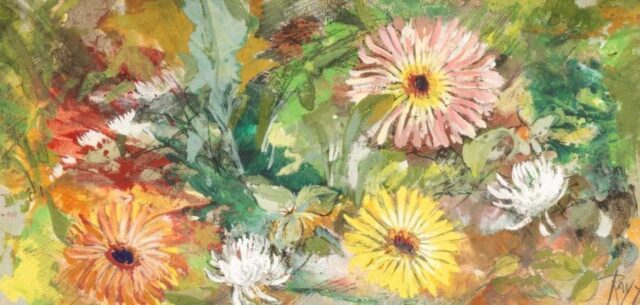
Even though Skomer is the Welsh subject with which her art practice is most closely associated to this day, Ray was drawn towards colour and light wherever she found it, and she could just as readily revel in the domesticated landscape of her “London Garden".
Ray Howard-Jones watercolour 'My London Garden'
The Welsh Sale (Part II), 23rd November 2026
£150-250
Mary Lloyd Jones
Making Her Mark
Colour is key as well to the ways in which Mary Lloyd Jones (b. 1934) expands on and diverges from the tradition of landscape art in Wales, for which she is being commemorated this year at the National Library with a monumental exhibition that charts the stages of her development as a professional artist.
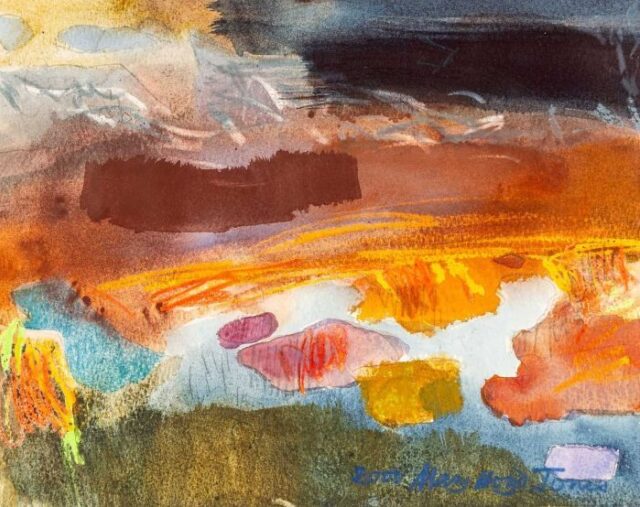
A “personal layered language of colour in response to the experience of particular locations is the foundation of my work,” Mary insists. This is apparent in Cors Goch Ystumtuen (2000), a mixed-media composition alive to the history inscribed in the industrially and colonially scarred environment of Ceredigion near her home in Aberystwyth. "Os chwiliwch chi gyda llygaid newydd,” Mary says in her first language, “fe welwch chi'r arwyddion a'r olion a adawyd gan ein hynafiaid cynnar" (“If you look with fresh eyes, you will see the signs and traces left by our early ancestors.”).
Mary Lloyd Jones watercolour and crayon 'Cors Goch, Ystumtuen, Red Bog 1'
The Welsh Sale (Part I), 22nd November 2026
£300-500
Some traces have been made and obscured more recently. Like other female artists of her generation, Mary was working in—and against—a patriarchal system in which the contributions that women made to society were, for the most part, consigned to anonymity. She remembers “coming across” a book titled An Historic Atlas of Ceredigion. Published in 1955, the year before Mary left Cardiff College of Art, it contained a list of “famous names associated with Ceredigion, 185 of whom were men but only one a woman.”
The fact that the “only” woman mentioned in the volume was born in the nineteenth century—namely, educator, writer-editor and temperance campaigner, Sarah Jane Rees (1839–1916)—was, to Mary, a “dramatic confirmation of the uncomfortable fact that in the culture which was my background, women were invisible and their achievements unrecorded.”
As the Welsh artist renaming himself Iwan Bala (b. 1956) has pointed out, Mary
"gained most knowledge of recent art, not through the college, but through illustrated books at Cardiff’s Central Library and from group trips to London’s galleries. There was little art in the National Museum of Wales that post-dated the Impressionist bequest of the Davies sisters."
Although a lack of contemporary female “role models” was, as Mary put it, a distinct “hurdle” for women artists born in the first half of the twentieth century, she has regarded as “heartening” a trend of “recent years” that “young Welsh artists” increasingly “choose to remain and work in Wales.”
Shared Inspirations
Joneses and Johns
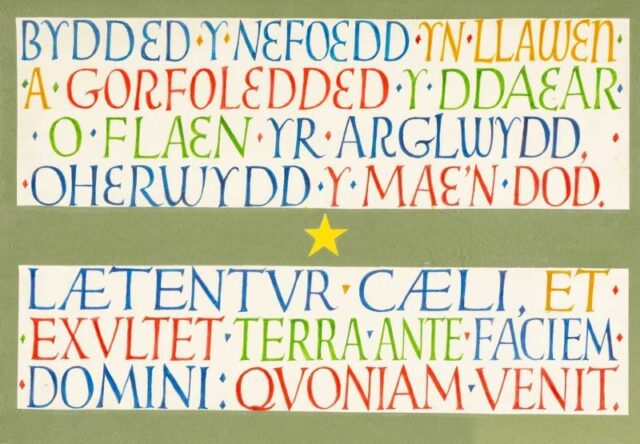
Whatever their heritage, the Joneses have long taken inspiration from each other. Born in North East England of Welsh descent, librarian-turned-artist/craftsman Jonah Jones (1919–2004) recalls being “so moved, so impressed” reading David Jones’s In Parenthesis (1937) as a young man that he believed it to have “marked a turning-point” in his life, especially since he found its author’s pride in the hybridity of his Anglo-Welsh identity reassuring. Jonah’s dual-language calligraphy attests to that profound sense of indebtedness.
Jonah Jones watercolour - 'Quia per Incarnati', hand lettered calligraphy inscription after British poet David Jones
The Welsh Sale (Part II), 23rd November 2026
£150-250
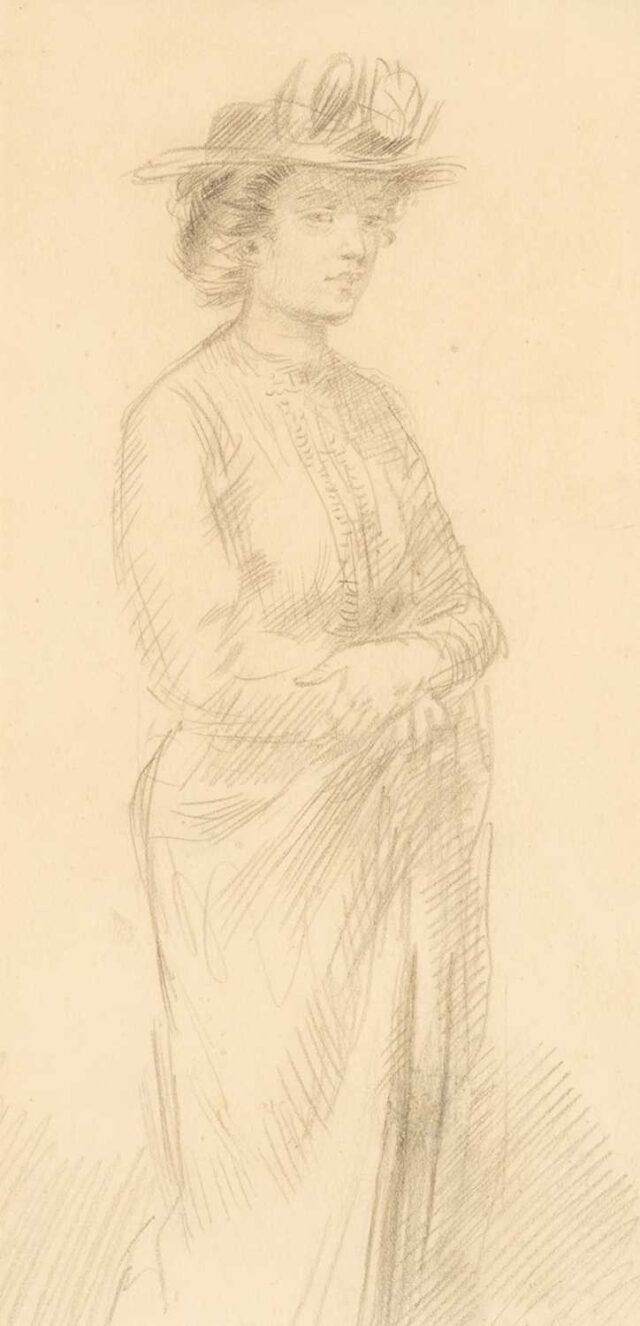
Meanwhile, Aneurin Jones, who declared that his own work showed “but little influence from the tuition” he received at art college, named Augustus John (1878–1961) among the artists to whom he “acknowledge[d] a debt.”
Augustus John pencil 'Portrait of Ida'
The Welsh Sale (Part I), 22nd November 2026
£2,000-3,000
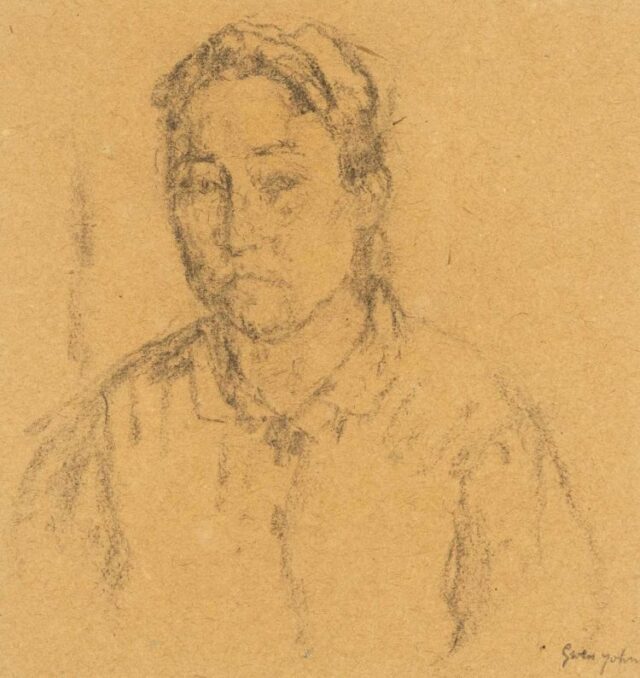
To be sure, Augustus and his elder sister Gwen (1876-1939) are paradigmatic of Welsh-born artists who made their mark elsewhere, in England and on the Continent, whereas the Welsh creatives that followed them could look up to exemplars in their midst and would benefit as well from international perspectives without leaving home.
Gwen John charcoal 'Portrait of a Woman'
The Welsh Sale (Part I), 22nd November 2026
£3,000-5,000
Mike Jones
Ordinary Lives, Lasting Impressions
Encouraged to draw at the age of nine after losing sight in one eye owing to a playful exchange with bows and arrows, Mike Jones (1941–2022) recalls seeing a Gold Medal award-winning painting by Josef Herman at the National Eisteddfod of Wales in Llanelli in 1962. It made a lasting impression on a young man who was discouraged at school from studying art and who pursued a career in local government instead. In the 1980s, by then a painter in his own right, Mike became friends with his idol.
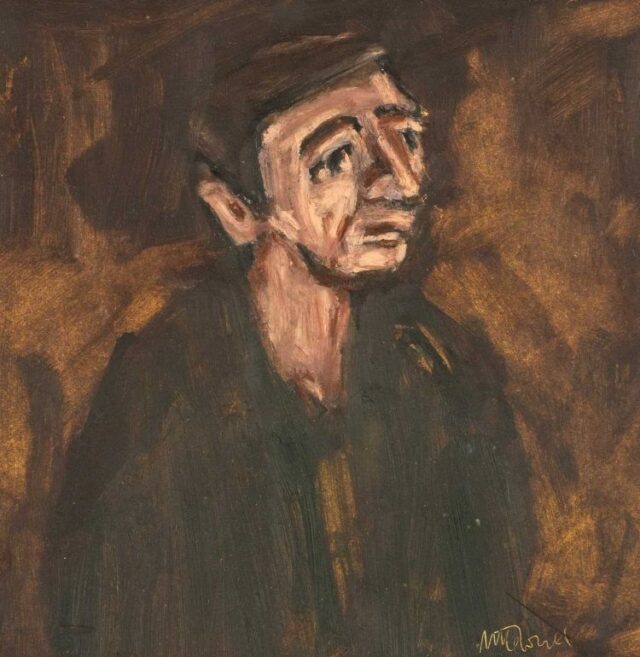
“People attract me far more than the landscape,” Mike commented in later life on the pull that faces and gestures exerted on him as an artist. The son of a miner, he chose to focus on the men and women whose names do not appear in our history books, ordinary folks too busy making a living to dream of seeing their names in lights.
Mike Jones oil on card 'Young Man'
The Welsh Sale (Part II), 23rd November 2026
£200-400
“Nomen est omen,” a Latin saying goes. Our names are signposts, pointing at once to the past and the future. Unlike the neighbouring Smiths, Taylors and Millers, who so rarely these days take the occupational paths spelled out for them, the Joneses of Wales have the good fortune of being free to fill their name with meanings of their own making so as to honour their forebears in any way they deem fit: painting, poetry, … you name it.
By Dr Harry Heuser
Writer, artist and exhibition curator based in Aberystwyth
Auction Information
Part I of our Autumn Welsh Sale takes place on Sunday 22nd November 2026 at our Cardiff saleroom.
Browse the full Welsh Sale (Part I) catalogue.
Part II of our Autumn Welsh Sale takes place on Monday 23rd November 2026 at our Cardiff saleroom.
Further Reading
Imminent Auctions
Thu 12 November 2026 10:00 AM
Luxury Gifts, Jewellery, Coins & Watches
Beautiful items consigned via our five hubs to the specialist pre-Christmas auction
Chester Saleroom
Tue 17 November 2026 10:00 AM
Colwyn Bay Monthly
Guitars | Furniture | Silver | Coins, Medals & Banknotes | Ceramics | Fine Art | Antiques & Collectables
Colwyn Bay
Thu 19 November 2026 1:00 PM
Beyond Europe
Asian, World & Ethnographic Arts
Cardiff Saleroom