
A to Z of Welsh Art: H is for Hiraeth
Representation, Relatability, and the Visual Language of Longing
In any language, there are words for which we will find no equivalents in the dictionary of another, words that resist literal translations. One such word is “hiraeth.” Unlike related terms such as “homesickness” and “nostalgia,” “hiraeth” carries weighty connotations particular to Wales as a nation—its history, geography, and culture—as well as denoting highly differentiated responses to what it means to hail from Wales, live in Wales or be part of the Welsh diaspora.
Whether it is triggered by natural sites or cultural references, by objects of everyday use imbued with family history and tradition, or by keenly felt intangibles such as the quality of light, “hiraeth” is compounded of intimate knowledge and individualistic associations, of past experiences and ever-present recollections, however coloured, clouded or capricious memory may become over time. It is to art that we turn to be transported, especially when “home” is beyond our reach.
The most sought-after objects in any Welsh Sale are not just of Welsh origin. They speak to us of Wales. And yet, many of the artists who are most closely identified with the visual culture of Wales were born and raised elsewhere. It is through their eyes that we become alive to what may be fading from view and look upon local character with a newfound appreciation.
Prominent among the exile and expatriate artists who have worked in Wales is Polish-born Jewish refugee Josef Herman (1920-1989). Herman’s output, varied though it is, remains closely associated with the historic mining community of Ystradgynlais in Powys, the working and domestic life of which he portrayed with intimacy and monumentalised in reverence. “‘You're no stranger here’—I was told the very day I arrived,” Herman recalled, looking back on his introduction to life in Ystradgynlais during the summer of 1944. “A day later I was addressed as "Joe," and now I am nicknamed ‘Joe bach,’—‘little Joe.’”
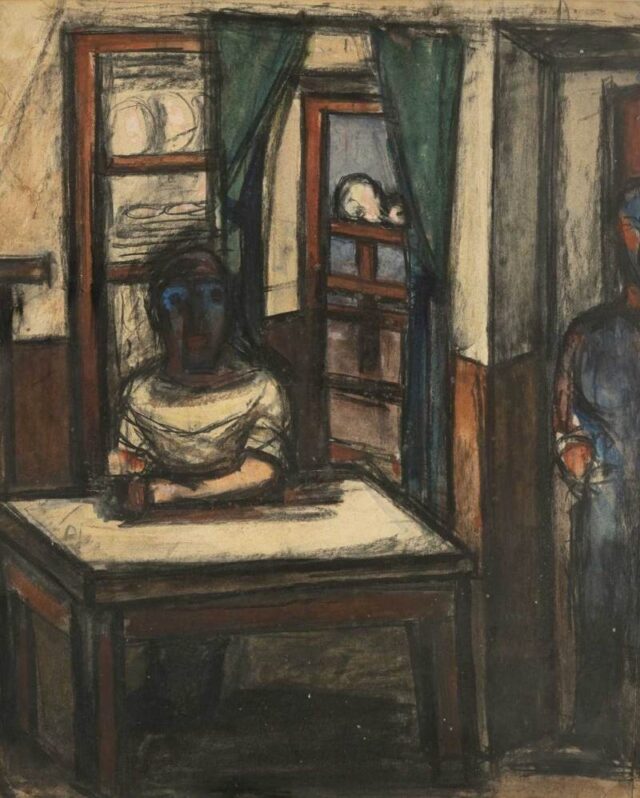
Herman’s arrival in South Wales marked the end of the “crisis,” both “spiritual” and “artistic,” he had experienced in wartime London. “The nostalgia for my childhood years had burnt itself out and nothing had taken its place except a vague feeling for big forms and a cry within me for a new belief in man’s serenity.” It was in Ystradgynlais that those “big forms” became flesh and the “new belief” took hold.
Paul Pieter Piech (1920–1996), a Brooklyn-born graphic artist and publisher of Ukrainian descent, likewise arrived in South Wales during the Second World War, where he met his future wife while serving in the United States Army Air Forces. His lino and woodcuts have featured prominently in past Rogers Jones auctions.
A politically engaged printmaker with a background in advertising, Piech created striking images designed to spread word about the fight for social justice globally while directing the worldwide attention his works could command to the struggle for Welsh identity. Deviating from his use of English-language slogans, Piech produced a series of linocuts referencing the Welsh National Anthem.
LOT 1
PAUL PETER PIECH woodcut print - the national anthem of Wales 'Hen Wlad Fy Nhadau' (Land of My Fathers)
£500-1,000
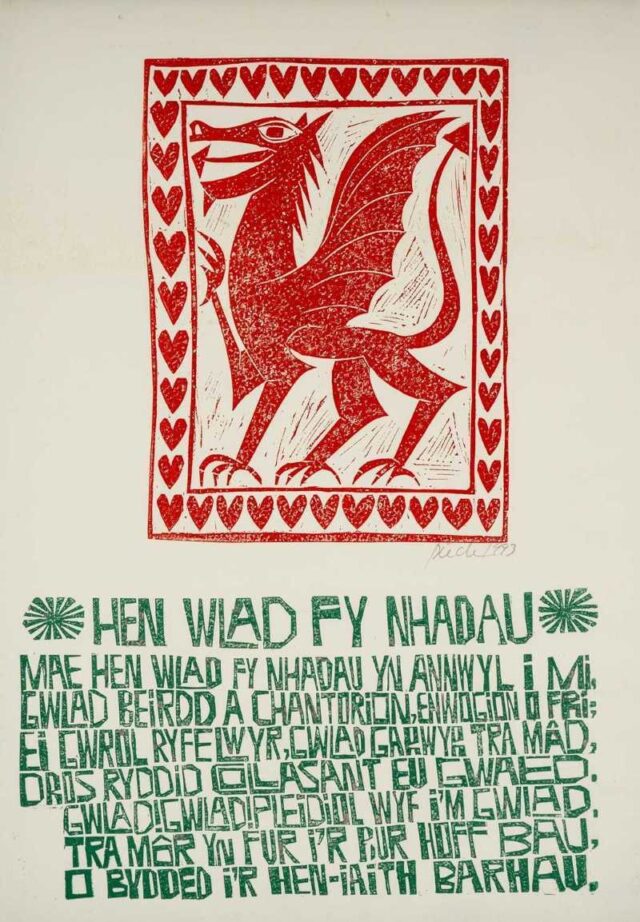
Toward the end of his career, Piech returned to South Wales and remained active during the final decade of his life while living in Porthcawl. Many of his later prints were concerned with pivotal moments in Welsh history, such as the 1984 Miners’ Strike and the closing of the last deep coal mine in South Wales a decade later.
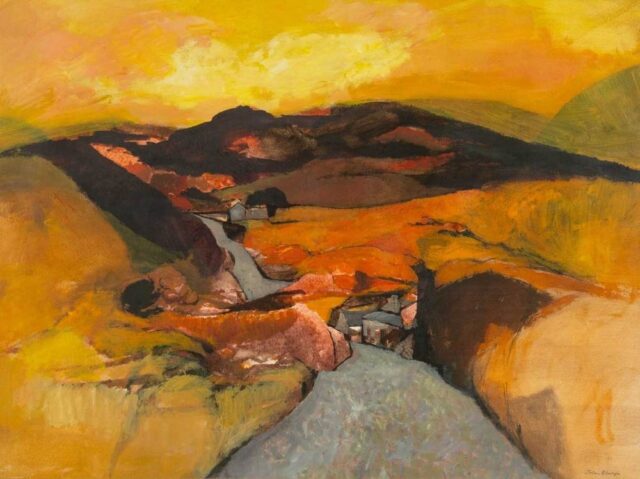
Meanwhile, Welsh-born artists who trained in England and lived outside of Wales for sustained periods of time, have often felt compelled to respond to suggestions their work was reactionary when acknowledging the hold that the Wales of their youth had on their imagination. “I have a parochial mind,” John Elwyn (1916-1997) once declared. “Some professional critics might label it as nostalgic.”
Elwyn was studying in London—the “centre of ‘the Great Wen’”—when he first “realised” that the “umbilical cord had not been severed.” Taking us at once forward and back, the winding country lanes at the centre of many of Elwyn’s now iconic Cardiganshire landscapes are visual metaphors for the lifeline that a “Celtic ancestry” became to a “young lad” who, as he expressed it at the outset of his career, “wanted to stand on his own feet in a Welsh way.”
Spending most of his life in Winchester, where he taught art and worked as an illustrator, Elwyn relied on images and visions of Wales that, stored in his memory, were, in his words, the product “of romantic longing in security.”
This sentiment is echoed by Kyffin Williams (1918-2006), a cultural ambassador so familiar to collectors worldwide that, despite the knighthood bestowed on him in 1999 for his outstanding services to the arts in Wales, he is generally referred to by his first name. “During the many years I spent in London, my mind was never far from the island and the shining water that surrounds it,” Kyffin reminisced about life on Anglesey, adding that, in “some strange way the strength of the land, as it stands resolute against the fury of the elements, has always given me a sense of security.”
This rock-solidness is rendered forcefully concrete in Standing Stones at Penrhos Feilw, a landscape that not only epitomises the brooding contemplation of what Kyffin called the “land of ochres and umbers,” but that aims to make aspects of Welsh identity manifest. Nature and culture, past and present, sacred and secular coalesce rather than clash as the eponymous monoliths, tonally echoing the distant coastline of Snowdonia, frame the vernacular architecture of a humble Welsh cottage with whose unassuming chimneys they are made to correspond.
LOT 96
SIR KYFFIN WILLIAMS RA oil on canvas 'Standing Stones at Penrhos Feilw'
£25,000-35,000
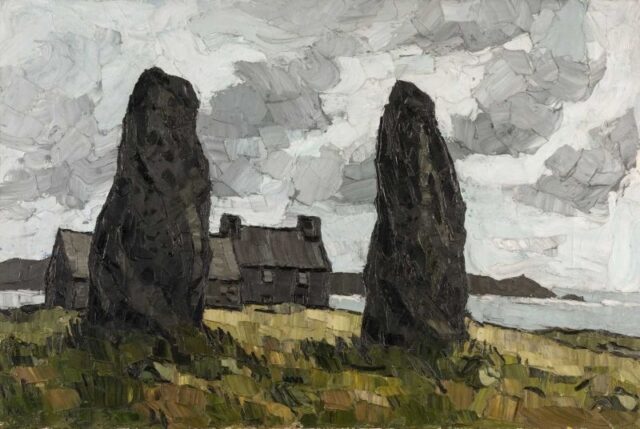
“All my pictures are based on real locations,” Kyffin stated early in his career, “even though my interpretation is free and imaginative.” To his mind, the “best landscape” was “necessarily an amalgam of fact and fiction.” And even though he claimed to “like landscapes and people too much to paint real abstracts,” abstraction was key to achieving what Kyffin referred to as “reality strategised by the imagination.”
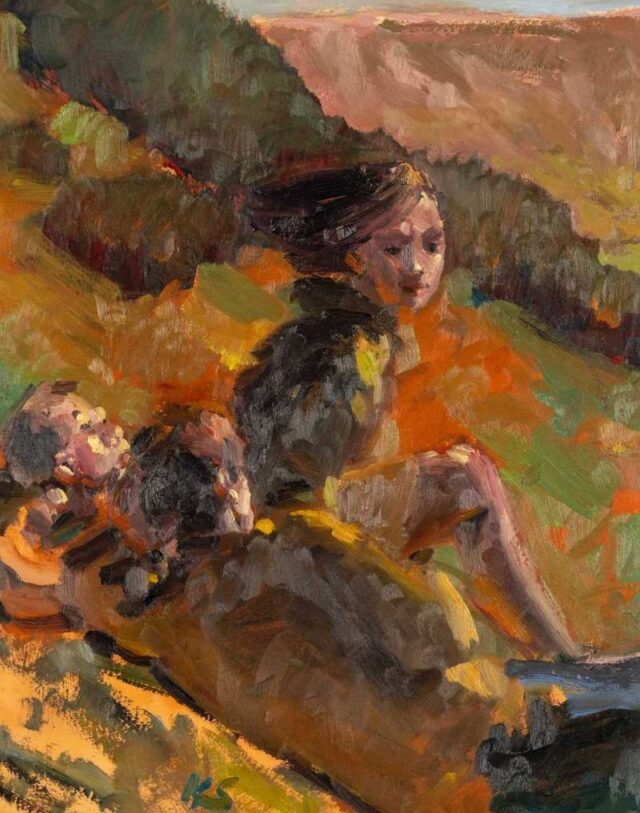
The “reality strategised” by many artists who came to be regarded as representative of Wales was distinctly localised, at times to a degree that made them question the relatability or translatability of their interpretations. In 1995, when painter Kevin Sinnott (b. 1947) returned to Wales, many years after achieving recognition in the artworld of London and New York City, he realised that even though he had been born in Sarn, “only seven miles away” from his “new home” in the Garw Valley, Sarn “was not in the valley.” He “had to re-learn how people related to one another; how 'stranger' meant something different in a place where everyone has got something to say to everyone else at any time.”
This “new body of work”—more narrative in nature—had, as he put it, “arisen from a growing awareness of [his] new home.” A “direct and deep response to the valley in which I now lived,” it had “come out of a spirit that would never have caught me during the years I painted in London.” Nonetheless, as “most of these pictures painted in the Garw Valley and about the Garw would be travelling up to London,” Sinnott began to wonder on whose walls they might end up. Now that his paintings had “this Welsh aspect to them,” he “doubted whether a London audience would get it.” Today’s less centralised, more diversified art market provides creatives in Wales with greater opportunities to reach segments of a heterogeneous audience that not only will “get” their work but that will want to get it.
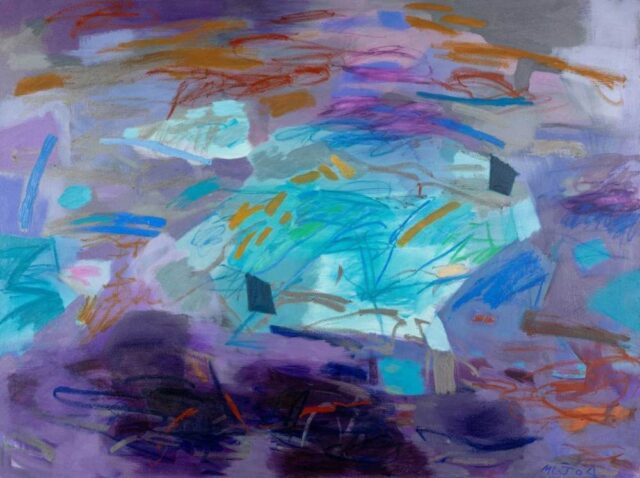
Ceredigion native Mary Lloyd Jones (b. 1934), who grew up in the remoteness of Devil’s Bridge, recalls a time when having a “career as a painter whilst living in west Wales” seemed to be an “impossible dream”—an ambition “doomed to failure.” Jones determined to “search for a visual language within the culture of Wales” while keeping the Welsh language visible. Although, as some of her works in this auction demonstrate, Jones has not entirely abandoned illusionistic approaches to landscape, her stated “aim is not to reproduce outward appearances but to attempt to convey the spirit of a particular place,” as well as to “create links with the past, to the lives of previous generations.”
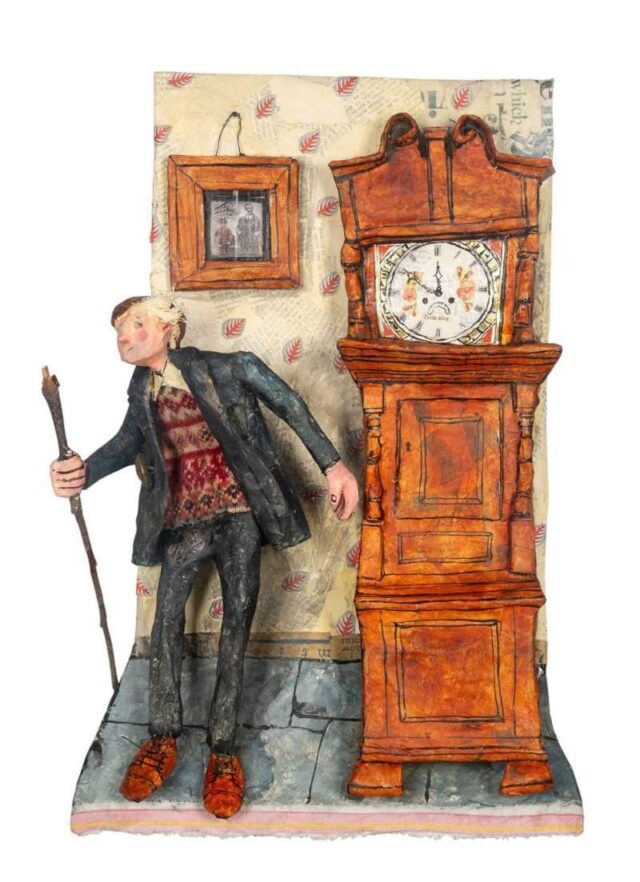
Bridging generations figuratively, North-Walian artist Luned Rhys Parri (b. 1970) asserts her distinctive voice in three-dimensional works that, at once whimsical and wistful, communicate an affection for times past, a “cloc taid” standing in for a way of life under threat of falling silent. To bring this point home, Parri, who acknowledges the political dimensions of her work, wallpapers her domestic interiors with pages from Welsh-language magazines and newspapers, ephemeral print she accords poignant visibility
LOT 146
LUNED RHYS PARRY mixed media construction 'Dewch i Mewn i'r Ysgwrn / Come Inside the Ysgwrn'
£300-400
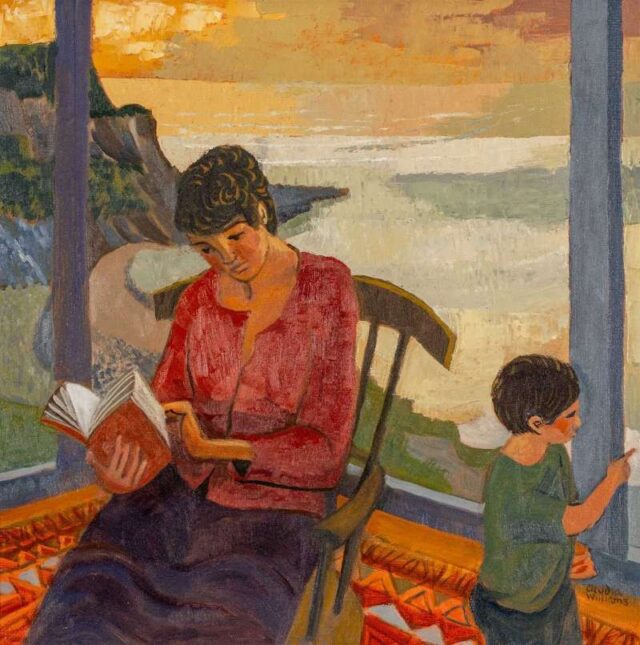
Figurative painter Claudia Williams (1933-2024) always regretted not having learned Welsh, of which her husband was a native speaker. Born in the south-east of England, Williams thought of herself as a “bit of an outsider,” even though she spent most of her adult life in Wales and, as she was keen to point out, her paternal great-grandfather was Welsh. Among her fondest childhood memories were summer holidays on the Anglesey coast. In later life, following her move to Pembrokeshire after years of living in France, Williams determined to renew her commitment to Welsh culture by commemorating the forced flooding of a Welsh community in the Tryweryn valley, a cultural touchstone that Parri and Jones have taken up as well.
Reading by the Bay Window subtly hints at this significant departure. A female figure, engrossed in a book, has her back turned to a seaside view to which a child, unobserved by her, is pointing—and to which Williams had been drawn all her life. The beach, Williams determined, had to wait. That same year, in 2005, she embarked on her Tryweryn series by reading up on historical accounts at the National Library of Wales, where many of the paintings are now preserved for the nation.
A decade earlier, reflecting how life abroad was changing his relationship with Wales, Williams’ husband, Gwilym Prichard (1931-2015) considered that, in contrast to his earlier paintings of Welsh cottages and farmhouses, his later landscapes were less “representational” and had “more feeling to them. I think probably something called hiraeth comes into the whole business of painting.”
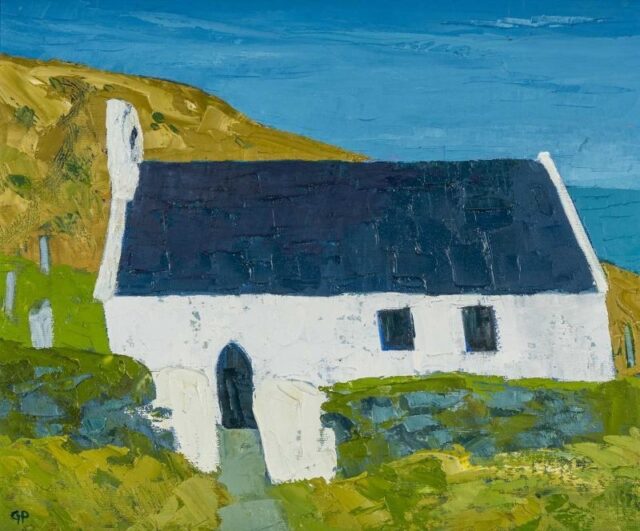
It is undoubtedly “something called hiraeth” that enters into the “whole business”—and spirit—of a Welsh Sale. Local and international collectors alike relate to works of art that, they sense, must come to a new home because they speak of home. We are drawn to images that, through the very specificity of their perceived Welshness, manage to tap into and perhaps even assuage our deep-rooted longing to belong, irrespective of our backgrounds and origins—an art that, knowing where we’re all coming from, reassuringly affirms: “You're no stranger here.”
By Dr Harry Heuser
Writer and exhibition curator
The April 19th Welsh Sale (Part I) catalogue is available to view online here.
Viewing can be arranged at our Cardiff auction house by appointment by calling us on 02920 708125. There will be an open viewing on Saturday 18th April from 10am-2pm.
Imminent Auctions

Ends: Sun 25 October 2026 8:00 PM
Groggs Galore: Timed Auction
Rare finds, familiar faces & collectables with character!
Cardiff Saleroom
Tue 27 October 2026 10:00 AM
Chester Monthly
Contemporary, Mid-Century & Antique Furniture & Furnishings | Jewellery, Coins & Watches | Pictures
Chester Saleroom

Thu 5 November 2026 10:00 AM
The Club House
Formula 1 | Rugby Union | Welsh Football incl. Ryan Giggs Match Worn | Medals & Militaria | Groggs ETC
Cardiff Saleroom