Echoes of Exile
Refugee Artists at The Welsh Sale
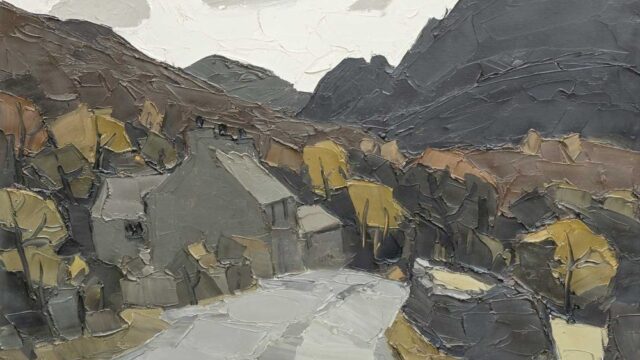
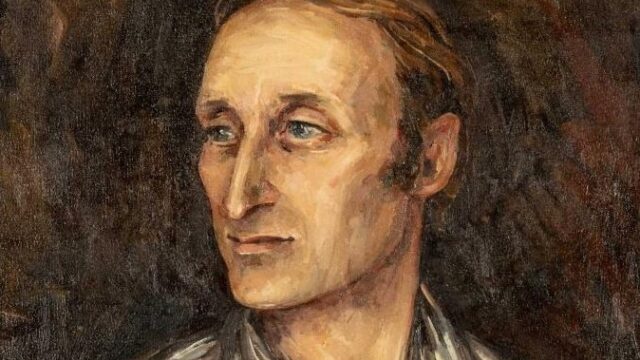
This July’s Welsh Sale features four extraordinary artists—Valerius de Saedeleer, Karel Lek, Josef Herman, and Heinz Koppel—bound by a powerful common thread: their shared history as continental European refugees who found geopolitical sanctuary and creative renewal in Wales.
Uprooted by the defining catastrophes of the twentieth century—namely the First World War and the rise of National Socialism—these artists arrived in Wales as outsiders.
Yet rather than remaining passive observers in exile, each actively synthesised their European training (from Flemish Symbolism to German Expressionism) with the rugged rural and industrial landscapes of their adopted home. Wales transformed from a temporary refuge into a vital creative catalyst. Through their work, these four artists introduced a profound, continental modernism to Wales, permanently reframing its valleys, industry, and communities through a lens of survival, empathy, and enduring human dignity.
Valerius de Saedeleer (1867–1941)
The Geography of Dislocation
Valerius de Saedeleer was already an established figure within the acclaimed Sint-Martens-Latem artist colony in Belgium, celebrated for his Symbolist-infused landscapes, when the German invasion of 1914 forced his family to flee. Sponsored by the influential Welsh art patrons Gwendoline and Margaret Davies, De Saedeleer and a circle of fellow Belgian émigrés were settled in the remote, sweeping terrain of Cwmystwyth, near Aberystwyth. He lived and worked in this rural isolation until 1920, when he returned to a liberated Belgium.
Confronted by the vast, stark topography of Ceredigion, De Saedeleer did not adopt the picturesque traditions of British romanticism. Instead, the empty Welsh hills became a visual vessel for his internal grief and homesickness.
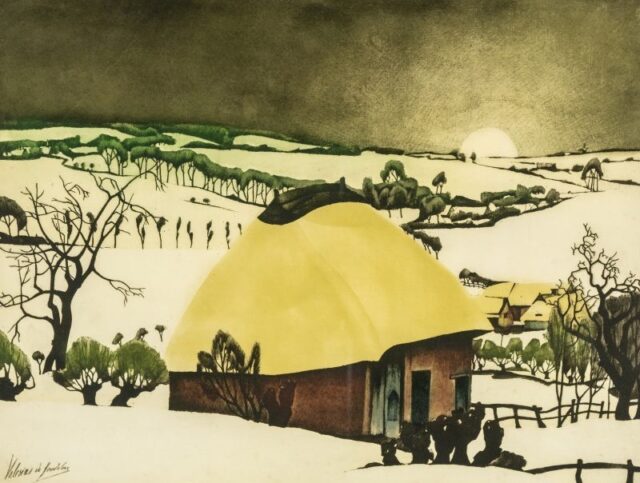
His notable Welsh works, such as Winter Landscape near Aberystwyth. This aesthetic transition is powerfully reflected in his later printmaking collaborations from the 1930s. In the striking colour etching and aquatint Winter in Etikhove (produced alongside printmaker Roger Hebbelinck after De Saedeleer’s 1928 canvas), we see the mature resolution of the style he refined during his years in Wales.
VALERIUS DE SAEDELEER etching and aquatint print - 'Winter in Etikhove'
Lot 21 - The Welsh Sale (Part 1)
£250-350
Karel Lek (1929–2020)
A Child’s Flight to Freedom
Unlike his contemporaries who arrived as mature artists, Karel Lek experienced displacement as a child. Born to a Jewish family in Antwerp, Belgium, Lek was only eleven when the Nazi blitzkrieg forced his family to flee across Europe in 1940. They ultimately found lasting safety in Bangor, North Wales. Lek went on to study at the Liverpool College of Art before settling permanently on the Isle of Anglesey (Beaumaris), where he became an integral part of the Welsh cultural fabric and a member of the Royal Cambrian Academy.
Artistic Legacy in Wales
Lek frequently observed that the democratic safety of North Wales granted him the psychological freedom to create. Having witnessed early anti-Semitic prejudice in Europe, his subsequent exile fostered a deep, lifelong fascination with the concept of shared humanity.
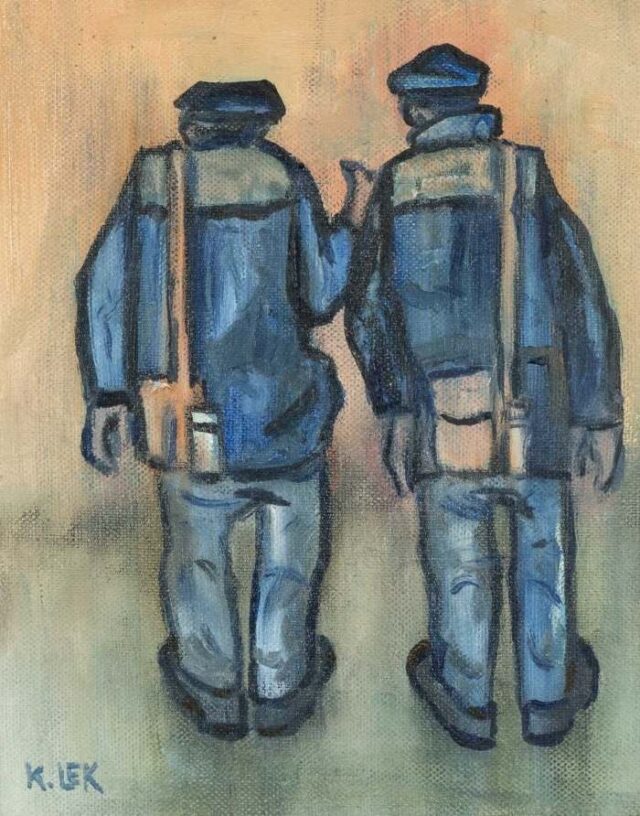
Avoiding grand political statements, Lek’s extensive body of expressionist drawings, paintings, and prints served as an intimate, empathetic chronicle of daily Welsh life and especially ordinary local folk engaged in quiet conversation on street corners and local jazz musicians absorbed in their performances.
Lek’s work beautifully balanced a childhood memory of tyranny with an enduring, gentle celebration of civic community.
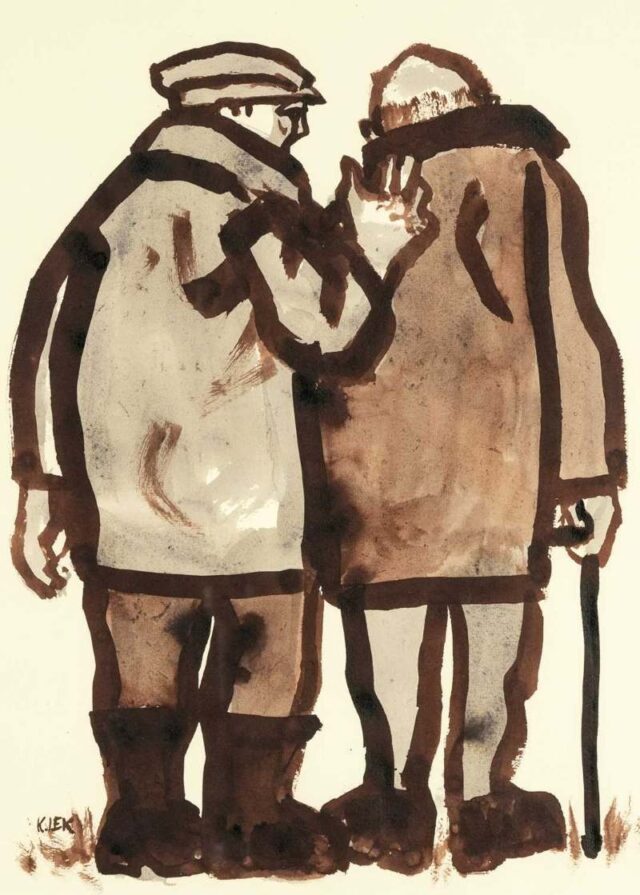
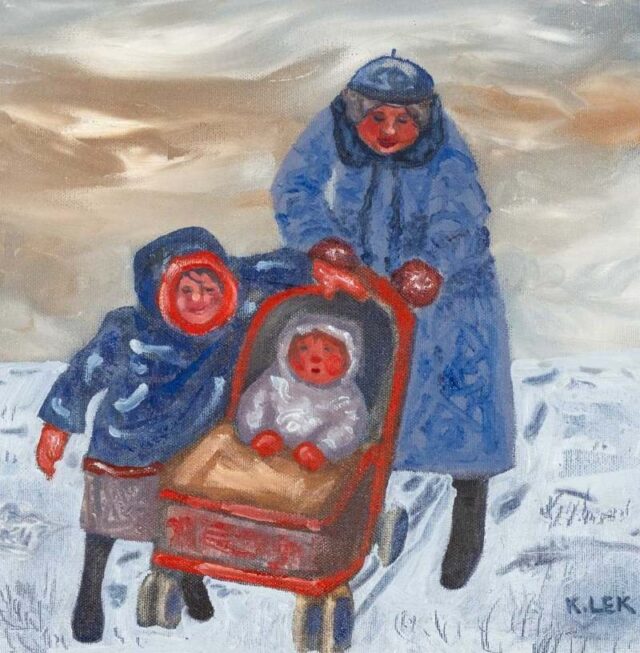
KAREL LEK oil - 'Bangor LMS Men (The Railway Men)'
Lot 181 - The Welsh Sale (Part 1)
£300-400
Josef Herman (1911–2000)
Sanctuary and Strength in the Welsh Valleys
Josef Herman’s journey to Wales was shaped by profound tragedy. Born into a working-class Jewish family in Warsaw, Poland, Herman fled the continent in 1938, arriving in Britain in 1940. It was during this period of displacement that he learned his entire immediate family had been murdered in the Holocaust. In 1944, seeking emotional and creative respite, Herman visited the South Wales mining village of Ystradgynlais. A planned two-week holiday turned into an eleven-year residency, with locals affectionately dubbing him "Joe Bach" (Little Joe).
Artistic Legacy in Wales
In the stoic, grit-stained miners of the Swansea Valley, Herman discovered an antidote to his profound alienation and grief. The miners represented an enduring, monumental strength that fascism had failed to crush.
Drawing upon European figurative masters like Constant Permeke, Herman depicted working people with a blocky, expressionistic mass, casting them in glowing, twilight ochres and deep earth tones. His work completely reconfigured the iconography of industrial Wales, stripping away sentimentality to elevate the Welsh coal miner into a universal, timeless symbol of human resilience and labour.
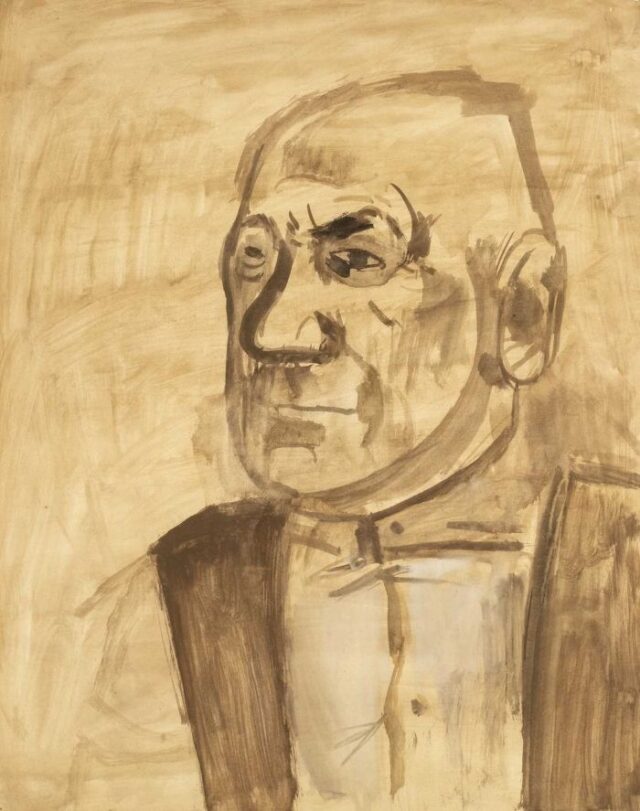
This thematic expansion is brilliantly captured in his powerful study, Burgundian Peasant (tempera and wash on paper, 1953), executed during a transformative journey to the French village of La Rochepot. Rather than aiming for a conventional portrait, Herman applies the same monumental, blocky expressionism to this French agricultural worker that he perfected while drawing Welsh pitmen.
The subject's head and shoulders are rendered with heavy, sculptural lines, eliminating trivial facial details to emphasize raw physical endurance. Executed in monochromatic, rich sepia washes, the palette roots the figure directly to the soil, echoing the twilight ochres of his famous mining panels.
Through drawings like Burgundian Peasant, Herman proves that his years in Wales were not an isolated experiment. Instead, the Valleys provided him with a timeless, humanistic template. Whether capturing a Welsh miner under the shadow of a coal tip or a French peasant in the fields of Burgundy, Herman used his art to construct a universal declaration of human survival.
Related reading: Josef Herman: Jo Bach of Ystradgynlais
JOSEF HERMAN tempera on paper - 'Burgundian Peasant'
Lot 38 - The Welsh Sale (Part 1)
£300-600
Heinz Koppel (1919–1980)
Processing Grief Through the Avant-Garde
Heinz Koppel was born to an affluent Jewish family in Berlin. Following the Nazi rise to power, his family fled first to Prague and then to London in 1938. Tragically, Koppel’s mother was unable to escape due to severe illness and was later murdered at the Treblinka extermination camp. In 1944, Koppel relocated to Dowlais, near Merthyr Tydfil, where his father had established a factory. Koppel lived, painted, and taught art in the South Wales Valleys for over a decade, later co-founding the influential "56 Group Wales" modern art society.
Artistic Legacy in Wales
Koppel’s art was a complex psychological crucible, deeply affected by the trauma of his mother's death and his own double displacement. In the fading, post-industrial landscape of Dowlais, Koppel found a physical environment that mirrored his internal state of ruin and survival.
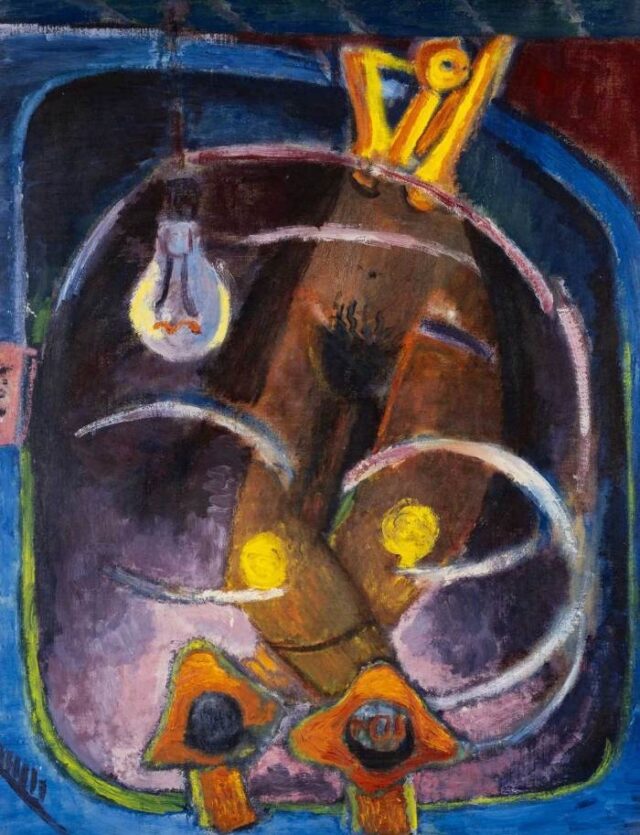
This intense psychological framing is powerfully demonstrated in Woman in a Bath.
Rather than treating the subject as a conventional, domestic nude, Koppel transforms the scene into a claustrophobic arena of German Expressionism and Surrealism.
The composition traps a stylized figure inside a starkly defined tub, viewed from an jarring, top-down perspective that heightens a sense of vulnerability and isolation. Above her hangs a stark, oversized light bulb casting a harsh, unyielding glow that slices through the murky background. While a bath typically implies a moment of relaxation, comfort, and cleansing, Koppel instead delivers an uncomfortable and uninviting scene. The unshaded lightbulb functions as the central metaphor of the piece; there is no hiding, and there is no comfort, reflecting the psychological terror and exposure his mother would have felt in her final years under the Nazi regime.
Through paintings like Woman in a Bath, Koppel moves far beyond the traditions of British figurative art. He reveals how his time in the industrial valleys of Wales allowed him to use ordinary domestic settings to channel the deep, underlying trauma of his family's displacement and the unsettling anxieties of post-war Europe.
Auction Information
The Welsh Sale takes place on 25th July at our saleroom in Cardiff. View the full catalogue here.