William Weston Young
We are absolutely thrilled to present two sensational lots in our upcoming July Welsh Sale celebrating William Weston Young.
His life story reads like a Hollywood script—honestly, someone get Benedict Cumberbatch’s agent on the phone because Young is the ultimate lead role. Born into a quiet Bristol Quaker family in 1776, this 19th-century polymath spent his 71 years refusing to be pinned down to just one career. He was a botanical illustrator, a porcelain entrepreneur, a land surveyor, a professional shipwreck salvager, and the accidental inventor of the modern blast-furnace brick. If you have ever admired fine porcelain at our previous auctions, or stood near an industrial kiln, you have crossed paths with his chaotic, brilliant legacy.
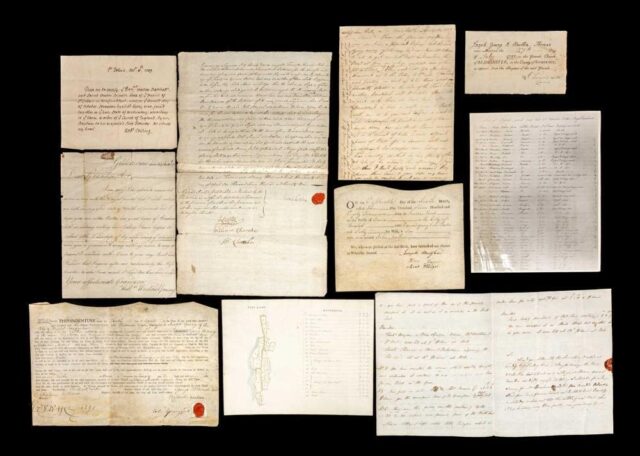
Young's life started with a literal bang when an 18-year-old attempt to emigrate to America went wildly off course. The French Revolutionary Wars were raging, and his vessel was intercepted by a formidable fleet of French men-of-war warships. Stripped of cargo and taken as a prisoner of war into a country gripped by the Reign of Terror, the pacifist teenager refused to break. He staged a daring escape from French custody and, penniless and hunted, navigated an arduous journey entirely on foot across Europe to find passage back to England. He collapsed back into the safety of Bristol in April 1795 and married his sweetheart, Elizabeth Davis, just days later. Our first sensational lot captures this exact high-seas drama. We are proud to offer an extraordinary archive of documents relating to the history of this intriguing man. Pulled together by a single dedicated collector over many years, this archive includes personal letters, historical accounts of his legendary escape from the French Navy, and much more.
£6,000-10,000
Following his dramatic return to Britain, Young sought a quieter life in the Neath Valley, where his precise sketches caught the eye of Lewis Weston Dillwyn at the Cambrian Pottery in Swansea. Instead of painting standard patterns, Young brought Welsh nature to life, hand-painting exquisite, scientifically accurate birds and botanical specimens onto clay. By 1814, his passion led him to invest his life savings into the Nantgarw China Works to back William Billingsley’s famously beautiful, yet fragile, translucent porcelain. It was a financial disaster. In 1820, his partners absconded in the middle of the night to escape mounting debts, leaving behind crates of unpainted porcelain blanks. In a stubborn move of pure resilience, Young bought up the remains and spent two years decorating the stock to satisfy angry creditors.
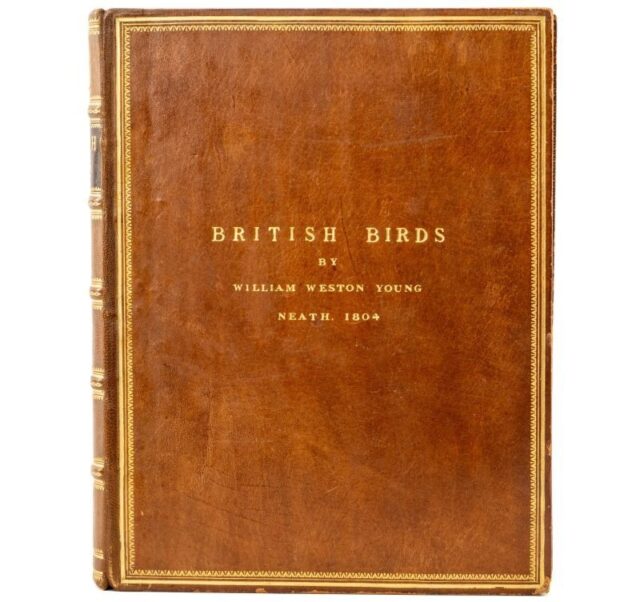
This desperate financial scramble birthed his most celebrated artistic achievement: the famous Nantgarw Bird Studies. Rather than copying stylized London trends, he painted the wild, native birds of Great Britain with flawless scientific precision. He isolated his subjects on simple, realism-styled detached branches or small patches of moss, using negative space to let the translucent porcelain breathe before framing them with a heavily gilded dentil border. Very few survived, making them the prize jewels of Welsh ceramic history. Our second spectacular lot offers a truly breath-taking look at these iconic ornithological studies. We are presenting Young’s original working drawings for his famous porcelain, preserved in fresh-as-a-daisy watercolour form within one beautifully bound volume. This book reads like a who’s who of Welsh collecting, having passed through the hands of the esteemed F.E. Andrews, a descendant of Solomon Andrews, the famous builder of Victorian Cardiff. Because of its museum-grade importance, we kindly request that viewers take great care, wear the supplied gloves, and browse this volume only if seriously interested in bidding.
WILLIAM WESTON YOUNG - An album of 41 fine watercolour drawings of birds
£20,000-25,000
Even a string of bankruptcies couldn't slow Young down, as he later pivoted to heavy industrial engineering. He used primitive diving setups to raise sunken ships from the treacherous Welsh coast, mapped the fast-growing industrial valleys of Glamorganshire as a land surveyor, and invented a pure silica firebrick that could withstand the extreme temperatures of blast furnaces, becoming a fundamental building block of the global Industrial Revolution. True to his chaotic track record, he never quite cashed in on his incredible invention, went bankrupt multiple times, and died back in Bristol in 1847. William Weston Young was the ultimate historical tinkerer—a man who couldn't look at a bird without wanting to paint it, a sunken ship without wanting to lift it, or a melting kiln without inventing a better brick to build it.
The Welsh Sale (Part II) will take place on 27th July at our saleroom in Cardiff.


Ben Rogers Jones BA (Anrh)
HYNAFOLION A CHELF GYMREIG & ARBENIGWR HEN BETHAU’R BYD CHWARAEON