
A to Z of Welsh Art: I is for Imagination
Vision and Poetry in the Visual Arts of Wales
Ahead of The Welsh Sale, we explore the relationship between imagination and Welsh art through works by artists including Karel Lek, Brenda Chamberlain, John Elwyn, Ceri Richards and Gwilym Prichard.
Together, these works explore how artists engage the viewer through memory, ambiguity and poetry.
Imagination and the Viewer
“Must a writer say all? Must a painter paint everything?” the eighteenth-century French philosopher and art critic Denis Diderot famously asked. The questions were rhetorical, expressive of an exasperation at the sight of compositions that, to his mind, were overwrought by an extravagance of visual information. Cannot the artist “leave anything at all to my imagination?” he protested.
Not all of us react quite as negatively to an absence of negative space or would go so far as to say that our appreciation of art is bedevilled by detail. And yet, marvel as we may at technical perfection or the faithful rendering of minutely observed reality, works of art tend to sustain our interest if they, in turn, work on us instead of creating the impression that their creators had it all worked out for us: art that raises our curiosity—not merely our eyebrows—and sets in motion trains of thought or flights of fancy that are fuelled by and refuelling a myriad of associations. When we say that something leaves nothing to the imagination, we are hardly being complimentary.
It is with the utmost simplicity of line that Shopping with Nan by Karel Lek (1929-2020) draws us in by drawing on our memories of childhood, when, being taken along to do grown-up things, even chores as mundane as getting groceries could feel like an adventure to us—and when, being entrusted into the care of our elderly grandparents, their hands, posture or gait first made us alive to their need of our care as well.
KAREL LEK acrylic 'Shopping with Nan'
Lot 484 - The Welsh Sale (Part II), 27th July
£200-350
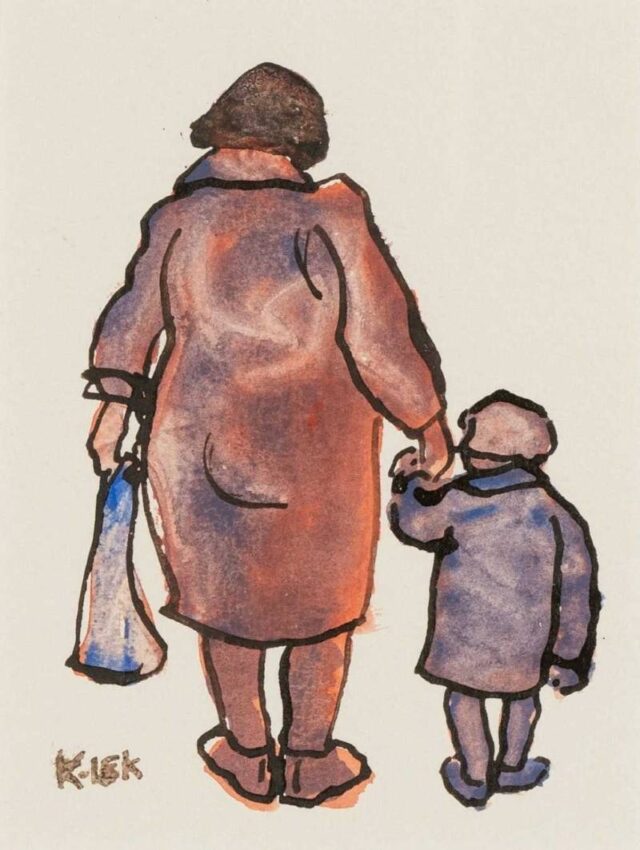
Insight into the artist’s life only confirms that “honesty” and “compassion” were key to Lek’s empathic vision. Born in Antwerp, Lek was taken to Bangor as a child of Jewish refugees who fled Belgium when Nazi occupation threatened their lives. An image that “always stayed with me,” Lek recalled, was how parents, “suitcase in one hand,” were holding onto their children as they set out to forge an uncertain future in a land where, he perceived upon arrival, people even “walked differently.”
In Lek, his friend Kyffin Williams (1918-2006) wrote, “we have a link with the continent and its long tradition.” One such “link” is Lek’s use of a device known as “Rückenfigur,” a German term for a figure shown from the back. Employed by Romantic artists to act as a stand-in for the viewer that was conceived to evoke feelings of awe and longing in sublime landscapes, in Lek’s pictures it encourages us to see beyond the differences that seem to separate us from our fellow beings and imagine ourselves in their shoes.
Ambiguity in Welsh Art
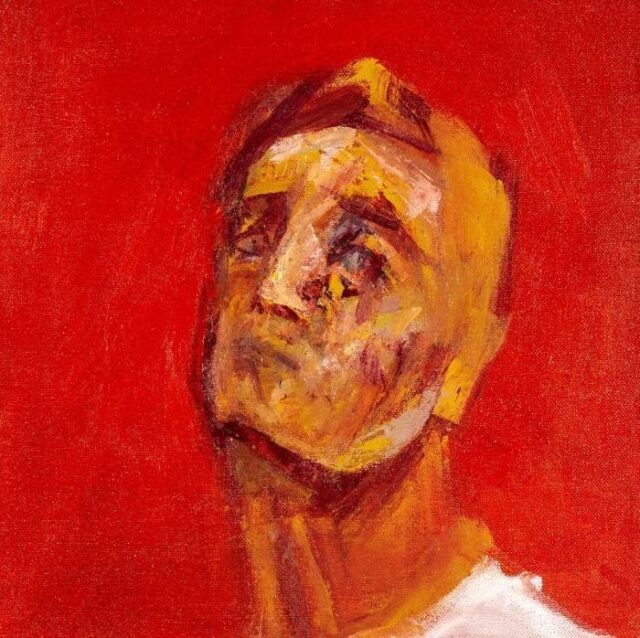
Images stir our imagination not simply by what they depict but by what they enable us to picture mentally. Visual information that is withheld from the viewer or narratives that are fragmented and inconclusive—not unlike the preparatory sketches, unfinished paintings and architectural ruins that enchanted the Romantics—can make our experience of art all the more captivating. In What Next? by Elfyn Jones (b. 1939), that idea is pushed further by way of a title that raises more questions than it answers about the indistinct figure with whose featureless three-quarter profile we are confronted. It is a strategy of addressing the viewer that Jones has employed in several of his paintings, including Now What? and Where Now? to underscore an atmosphere of unresolved tension.
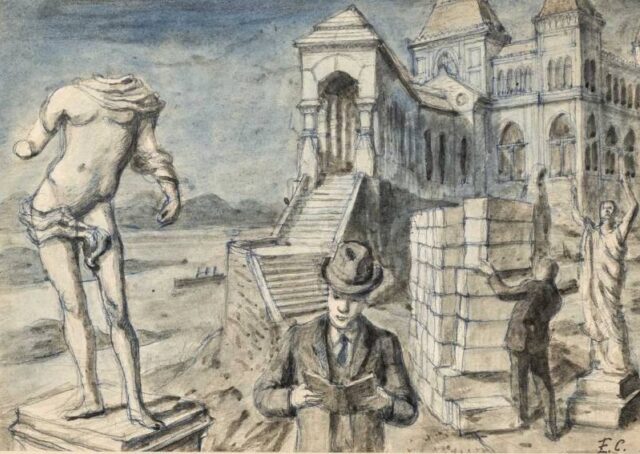
“I want ambiguity,” Felicity Charlton (1913-1918) declared in later life as she recalled the, to her mind, bewildering speculations about possible real-life references in compositions that were envisioned as an “imaginative parallel” of reality. The Bristol-born painter, who relocated permanently to South Wales when she was in her mid-twenties, found it exasperating that “[p]eople want there to be an explanation.”
Being able to confirm a suspicion that Charlton and her husband—painter, educator and first HMI (Her Majesty's Inspector) for Art in Wales, Evan Charlton (1904-1984)—were under the spell of the eighteenth-century artist and archaeologist Giovanni Battista Piranesi by learning that, indeed, original prints by Piranesi were displayed on the walls of their home in Barry does not dispel the the mystery of Felicity’s haunting mixed media composition showing two male figures in contemporary dress surveying an otherwise deserted site of antiquity.
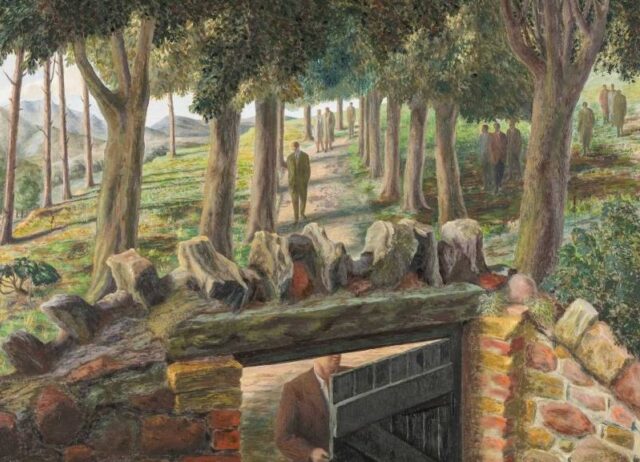
A painting such as The Lodge (c. 1953)—the title of which invites association with the secretive world of freemasonry—is not so much open to more than one interpretation as it defies demystification altogether. Unable to piece together an unequivocal narrative based on visual clues, we are reminded that mysteries are antithetical to puzzles in that the latter is designed to be solvable whereas the former, unless understood as a product of detective fiction, depends on ambiguity for its very existence.
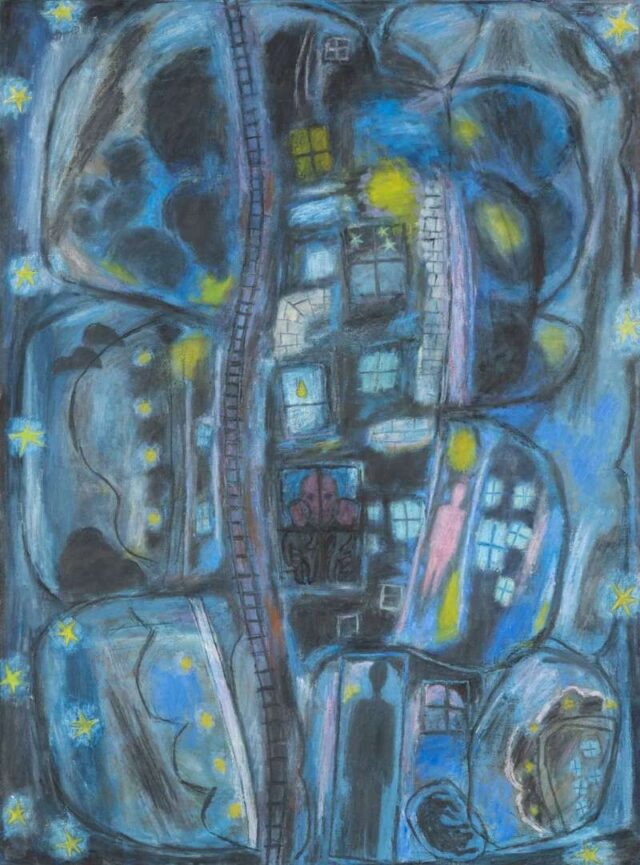
“The standard of a work of art does not depend on the extent to which it represents nature,” Ernest Zobole (1929–1999) defiantly stated at the beginning of his career. “If it did, then of course all photographs would be supreme works of art.” Created at the end of his career, Painting About a Landscape (1997) articulates Zobole’s attitude towards representation pictorially. To Zobole, the colour blue was “indicative of space” as “something not solid.” Its “non-objective” use gave him the freedom to “move about in the space of the painting” that, as the title suggests, is not itself a landscape but a contemplation of landscape as a construct. Not that getting the idea makes Zobole’s pictures any less magical to us.
ERNEST ZOBOLE oil 'Painting About a Landscape'
Lot 255 - The Welsh Sale, 25th July
£1,000-2,000
Poetry and the Welsh Imagination
“The artist, thank heaven, has not the eye of the camera," Brenda Chamberlain (1912-1971) remarked. Chamberlain defined a “work of art” as a “mystery that springs partly from nature and partly from the inner world of the artist.” Whether this “inner world” is “rooted in reality” or in “dream or myth or phantasy,” it follows a “private pattern.” An “individual idiom” that, “from which ever root it grows,” it is the “signature of the artist.”
In Tide-Race (1962), her personal reflections on living in the remoteness of Ynys Enlli (Bardsey Island), Chamberlain went further still by saying that her “real life,” unlike a quotidian existence circumscribed by “the task of running a household” or “being part of a community,” was “of the imagination.”
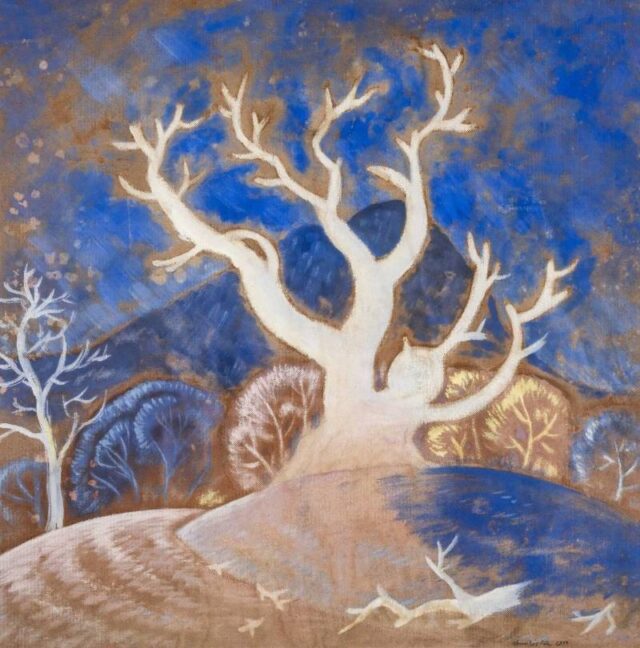
Ty'r Mynydd Hills, Bangor (1937) draws us into that “real life”—a realm beyond the painting’s ostensible view from Ty'r Mynydd, the “mountain house” where, prior to her move to Ynys Enlli, Chamberlain lived and worked with her husband, engraver and designer John Petts (1914-1991). It is tempting to read the pale, bare tree reaching up into the night sky despite having lost some of its branches as a visual metaphor for a creative vision asserting itself against forces opposing its growth. And yet, it was at Ty'r Mynydd that Chamberlain and Petts jointly embarked on the ambitious venture of setting up a private press.
BRENDA CHAMBERLAIN oil 'Ty'r Mynydd Hills, Bangor'
Lot 241 - The Welsh Sale, 25th July
£700-1,000
During the Second World War, the couple collaborated with poet Alun Lewis (1914-1944), on the Caseg Broadsheets, of which there is a complete set in this auction.
JOHN PETTS complete set of eight Caseg Broadsheet wood-engravings
Lot 397 - The Welsh Sale (Part II), 27th July
£200-300
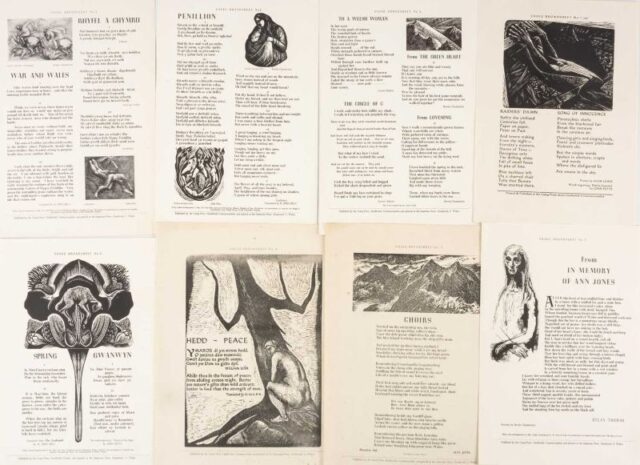
Curtailed though it was by wartime rationing of paper, Caseg Press allowed Chamberlain, herself a poet, to align her art practice with the literary imagination and bardic tradition of Wales that, until the middle of the twentieth century, overshadowed the visual arts to such an extent that Wales was believed to be, above all, a land of song.
Verse ranging from Y Cynfeirdd ("The earliest poets") to an extract of “After the Funeral” by Dylan Thomas was presented alongside wood engravings and drawings by Petts and Chamberlain. While the artworks are in some cases illustrative and quite small, Petts’ design for Caseg Broadsheet No. 6—the last of the eight Broadsheets to be published—achieves an alchemic synthesis of word and image in which the latter is neither ancillary to nor competing with the former.
The literary imagination of Wales has played a significant role in shaping art that is lyrical rather literal or imitative in its approach to nature and observed reality. Referring to himself as a “romantic at heart,” John Elwyn (1916-1997) acknowledged that, as a painter, he required “inspiration” from the “outside,” be it a “shower of rain in April or perhaps a line of poetry. Something to make the imagination move and start creating a mirror of thoughts and reflection of feelings.”
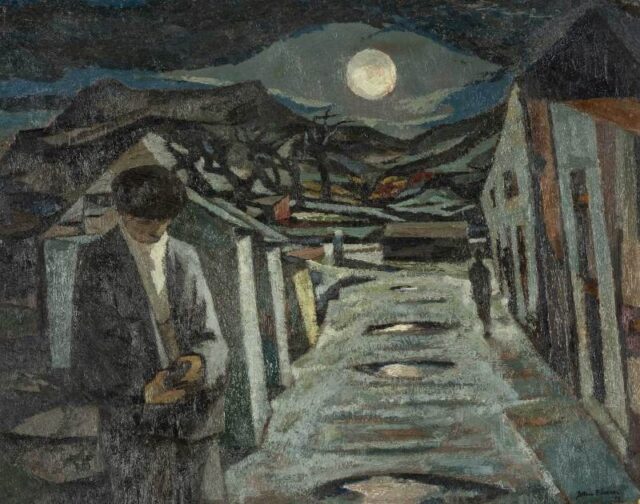
Whatever their source of “inspiration,” Elwyn’s paintings are the manifestations of a poetic spirit that animates compositions such as The Miner and the Moon (1952), an enigmatic composition that stands out among several variations on the theme of miners returning home at the end of their workday. Executed between 1951 and 1952, the paintings were based on Elwyn’s memories of living in the mining community of Pont-Rhyd-y-Fen a decade earlier.
In the 1970s, Elwyn devoted several paintings to “Fernhill” (1946) by Dylan Thomas. It was the artist’s favourite poem. A decade later, in 1988, following a visit to the poet’s Boat House, a writing shed overlooking the estuary of the River Taf, Elwyn created a series of watercolours, one of which he turned into a now highly sought-after print.
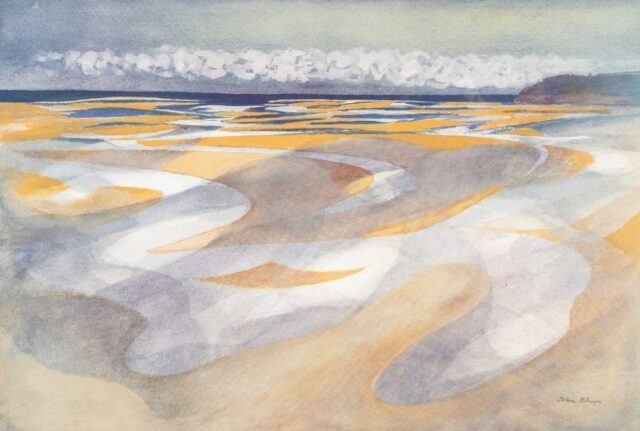
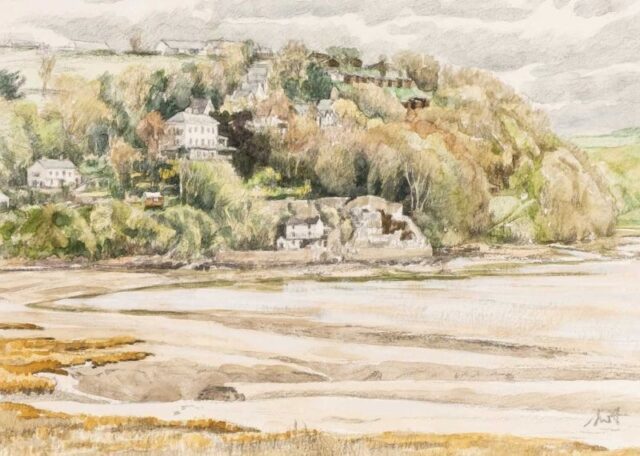
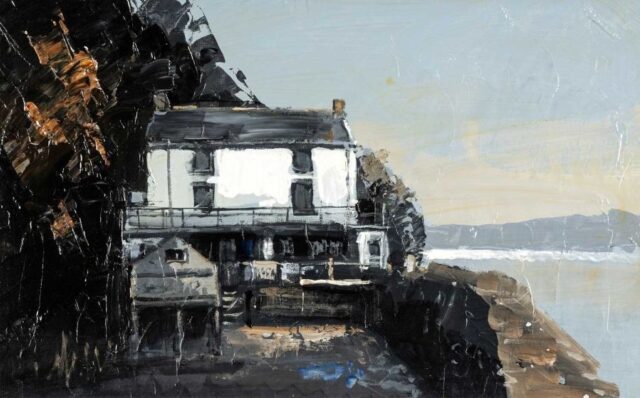
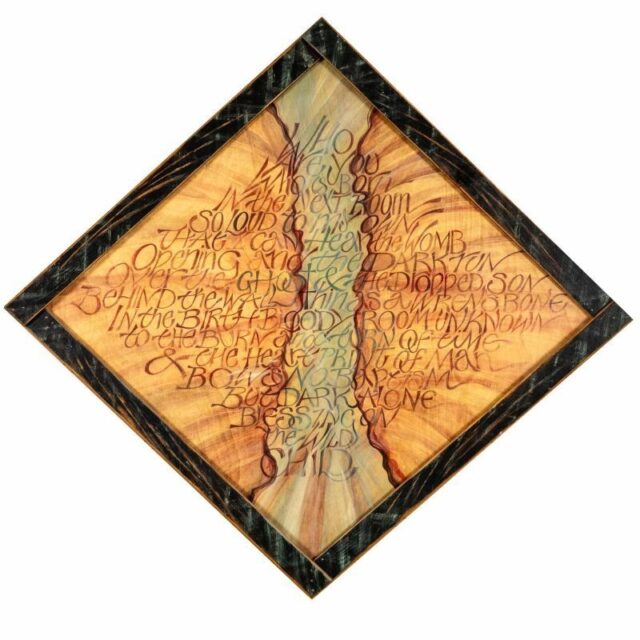
A number of works in the present auction reference Dylan Thomas by name or quote from his works; they range from a watercolour of Thomas’s “Boat House” by Steve Alport (b. 1945) and an oil painting by Derek Williams (1932-2009) of the same subject to a calligraphic re-visualisation of the first stanza of Thomas’s pattern poem “Vision and Prayer” (1944) by Eleanor Glover (b. 1952).
STEVE ALPORT watercolour 'Dylan Thomas' Boathouse and Writing Shed, Laugharne'
Lot 443 - The Welsh Sale (Part II), 27th July
£100-150
ELEANOR GLOVER paint & calligraphy 'Poem by Dylan Thomas'
Lot 193 - The Welsh Sale, 25th July
£300-400
Unquestionably, the internationally most recognised Welsh artist to engage with Thomas’s poetry is Ceri Richards (1903-1971). As translator, art and literary critic Roberto Sanesi observed, Richards’ “imagination” and “technique operate on poetic lines” that correspond closely with those employed by Thomas in that both tended “towards proliferation, association and cyclical return.”
In 1943, Richards was commissioned to create an image for the cover for the literary magazine Poetry London, incorporating the periodical’s signature lyre bird motif. Richards readily obliged but, due to wartime restrictions on printing, his colourful designs were not published until 1947, by which time they had transmogrified into the lithograph that appeared as a double-sided inset in the magazine’s first post-war issue. In the “British art of the time,” Richards’ biographer Mel Gooding enthused, there “are few images to match” this particular print.
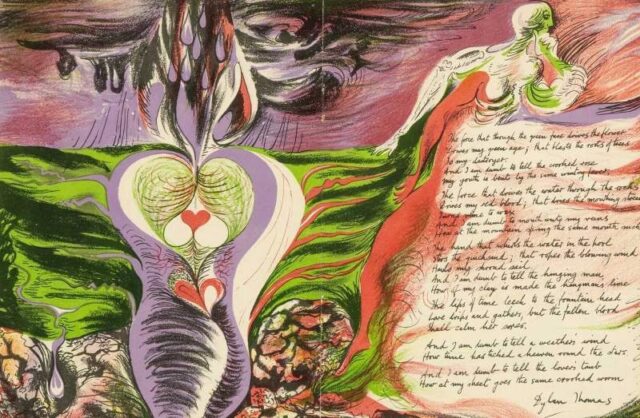
Integrating lines copied from “The Force That Through the Green Fuse Drives the Flower” (1933) in his own hand, Richards acknowledges his dept to the source—the “Force” of poetry that drives the flowering of his imagination. No attempt is made to interpret the text, let alone spell out its meaning. Instead, the composition suggests a spirit of collaboration and mutual understanding, even though artist and poet did not meet until October 1953, just weeks before Thomas’s death.
The Celtic Imagination in Welsh Art
Commenting on the inscrutable depth of early oil paintings by Gwilym Prichard (1931-2015), such as the Anglesey landscape in the present auction, Richards observed that Prichard did not so much paint the visible surface of the land but the “bones beneath” it. The art collector Lord Michael Croft referred to this fascination with the secrets of an ancient land as Prichard’s “Celtic imagination,” which he defined as a “kind of mysticism”—a “capacity to feel the spell of the past” and to “find behind surface appearance a deeper sense of reality” that “relates the particular to the whole.”
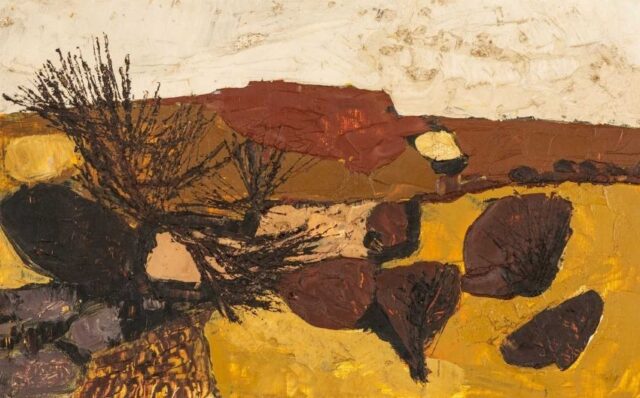
In the introduction to his memoir A Wider Sky (1991), Kyffin Williams light-heartedly apologised for his own “Celtic imagination,” expressing the hope that it was not too “lively” to interfere with the task of being “as accurate as possible” in his recollections. Clearly, as an autobiographer he looked differently at fidelity in representation—and the trust on which truth-telling is based—than as an artist whose evocative landscapes, while grounded in observation, imaginatively bridge the world of nature with the realm of art.
When we say “I get the picture,” we signal a readiness to draw a line under a subject we presume to understand sufficiently not to entertain it further. That is, we are no longer entertained by it. One of Diderot’s contemporaries, the British philosopher and statesman Edmund Burke, observed in his reflections on “Infinity in Pleasing Objects” that the “imagination is entertained with the promise of something more” than the factual or the finite. Presented with such a promise, who among us would settle for less?
By Dr Harry Heuser
Writer and exhibition curator
Auction Information
Further Reading
Imminent Auctions

Ends: Sun 25 October 2026 8:00 PM
Groggs Galore: Timed Auction
Rare finds, familiar faces & collectables with character!
Cardiff Saleroom

Tue 27 October 2026 10:00 AM
Chester Monthly
Contemporary, Mid-Century & Antique Furniture & Furnishings | Jewellery, Coins & Watches | Pictures
Chester Saleroom

Thu 5 November 2026 10:00 AM
The Club House
Motor Sports | Rugby Union & League | Football | Medals & Militaria | Railway memorabilia ETC
Cardiff Saleroom