Louis Wain and His Cats
Louis Wain was one of the most popular artists of late Victorian and Edwardian Britain, famous for his comical, anthropomorphic cats. But behind his whimsical creations lay a life marred by financial struggle, personal tragedy, and declining mental health.
Born in 1860 in Clerkenwell, London, Wain was the eldest child and only brother to five younger sisters. By his own account he was a poor student, but he showed an early talent for drawing. He attended the West London School of Art, where he later became a teacher. In 1881 he sold his first drawing to the Illustrated Sporting and Dramatic News, and soon afterwards left the security of his teaching position to pursue a career as a freelance artist.
Three years later he married Emily Marie Richardson, his sisters’ former governess, who was ten years his senior—a union that caused a temporary rift with his family. Not long after their marriage, Emily was diagnosed with breast cancer. During her illness, her main comfort was the couple’s black-and-white kitten, Peter. Wain would teach Peter tricks and sketch him to amuse her, and it was Emily who encouraged him to try to sell these drawings.
At first, Wain did not consider cat illustrations commercially viable. He later recalled in 1909 that when he began drawing them, cats were still widely regarded as despised animals. In 1886, however, he persuaded The Illustrated London News to publish A Kitten’s Christmas Party in its Christmas edition. The illustration, featuring eleven scenes of kittens (many based on Peter) engaged in human activities such as playing games and making speeches, was an immediate success.
The celebration was short lived. Emily died in early 1887, just three years into their marriage.
After the death of his wife Wain reconciled with his mother and sisters and the family moved together to Westgate-on-Sea in Kent, with Wain as the sole breadwinner. During this period, he developed his distinctive style, increasingly depicting cats with human characteristics. He was an extraordinarily prolific artist, producing hundreds of drawings each year. Over the course of his career, he illustrated around a hundred children’s books and produced the Louis Wain Annual from 1901 to 1915. His work also appeared widely in magazines and journals, as well as on postcards and advertisements.
Despite this success, often struggled for money. Wain had little head for business, and his shy nature made it difficult for him to negotiate with publishers. He often sold his work—and its copyright—outright for small sums, receiving no royalties. He sometimes had to borrow money for his train fare home if he had been paid by cheque, and would often settle rent with quickly sketched drawings of cats.
With the advent of the First World War, demand for Wain’s work declined, placing him under increasing financial strain. The death of his sister Caroline in 1917 greatly affected him, and his mental health began to deteriorate. He developed delusions, claiming to be haunted by spirits, and became increasingly volatile, accusing his sisters of theft and blaming them for Caroline’s death. Eventually, his behaviour became too difficult to manage, and in 1924 he was certified insane and admitted to the paupers’ ward of Springfield Mental Hospital.
Even in institutional care, Wain continued to draw. His sisters visited weekly, bringing him art supplies and taking away completed works to sell. During this period, he experimented more with his style, often incorporating intricate patterns—sometimes described as “wallpaper designs”—into the backgrounds of his paintings, and producing increasingly abstract images. He has often been thought to have had schizophrenia, and some have attempted to trace the progression of his illness through changes in his art. However since few of his works were dated, attempts to link them to his illness are speculative at best.
A year after being institutionalised, Wain was discovered at Springfield by the bookseller Dan Rider, who was shocked that such a well-known artist was living in such poor conditions. He decided to establish the Louis Wain Fund to raise money for Wain and, later, for his sisters. The campaign gained significant support, including from the author H.G. Wells and Prime Minister Ramsay MacDonald. Thanks to this outpouring of public concern, Wain was transferred first to Bethlem Royal Hospital and later to Napsbury Hospital near St Albans.
There, in more comfortable surroundings, he continued to draw and paint for the rest of his life. His sisters received small pensions in recognition of their brother’s contributions to popular art. He died in 1939, leaving a body of work that transformed the public perception of domestic cats. As H.G. Wells noted during a 1925 radio broadcast: “He has made the cat his own. He invented a cat style, a cat society, a whole cat world. English cats that do not look and live like Louis Wain cats are ashamed of themselves.”
Why is Louis Wain's art so collectable?
With the advent of the First World War, demand for Wain’s work declined, placing him under increasing financial strain. The death of his sister Caroline in 1917 greatly affected him, and his mental health began to deteriorate. He developed delusions, claiming to be haunted by spirits, and became increasingly volatile, accusing his sisters of theft and blaming them for Caroline’s death. Eventually, his behaviour became too difficult to manage, and in 1924 he was certified insane and admitted to the paupers’ ward of Springfield Mental Hospital.
Even in institutional care, Wain continued to draw. His sisters visited weekly, bringing him art supplies and taking away completed works to sell. During this period, he experimented more with his style, often incorporating intricate patterns—sometimes described as “wallpaper designs”—into the backgrounds of his paintings, and producing increasingly abstract images.
What makes Louis Wain’s cat paintings so unique?
At first, Wain did not consider cat illustrations commercially viable. He later recalled in 1909 that when he began drawing them, cats were still widely regarded as despised animals. In 1886, however, he persuaded The Illustrated London News to publish A Kitten’s Christmas Party in its Christmas edition. The illustration, featuring eleven scenes of kittens (many based on Peter) engaged in human activities such as playing games and making speeches, was an immediate success.
After his wife's death, Wain developed his distinctive style, increasingly depicting cats with human characteristics. He was an extraordinarily prolific artist, producing hundreds of drawings each year. His work also appeared widely in magazines and journals, as well as on postcards and advertisements.
As H.G. Wells noted during a 1925 radio broadcast: “He has made the cat his own. He invented a cat style, a cat society, a whole cat world. English cats that do not look and live like Louis Wain cats are ashamed of themselves.”
The First World War, increasing financial strain and the death of his sister Caroline in 1917 had a profound impact on Louis Wain’s mental health. As his condition deteriorated, his behaviour became increasingly erratic and in 1924, he was admitted to Springfield Mental Hospital in London.
Despite these personal difficulties, Wain continued to create art throughout his time in institutional care. His sisters visited weekly, bringing him art supplies and helping to sell his drawings and paintings. During this period, his work evolved dramatically, becoming more experimental and visually complex.
Many of Wain’s later compositions featured intricate geometric patterns, bold colour combinations and highly decorative backgrounds, creating the distinctive images now often referred to as his “psychedelic cats”. These striking works remain among the most fascinating and collectable examples of Louis Wain art today, admired for their originality and almost abstract quality.
Although his later paintings have frequently been linked to his declining mental health, art historians continue to debate the extent to which his changing style reflected his illness. Regardless, these imaginative and visually unique works occupy an important place within British art history and continue to generate strong interest among collectors buying art at auction. He died in 1939, leaving a body of work that transformed the public perception of domestic cats.
Buying Louis Wain art at auction
£4,000-6,000
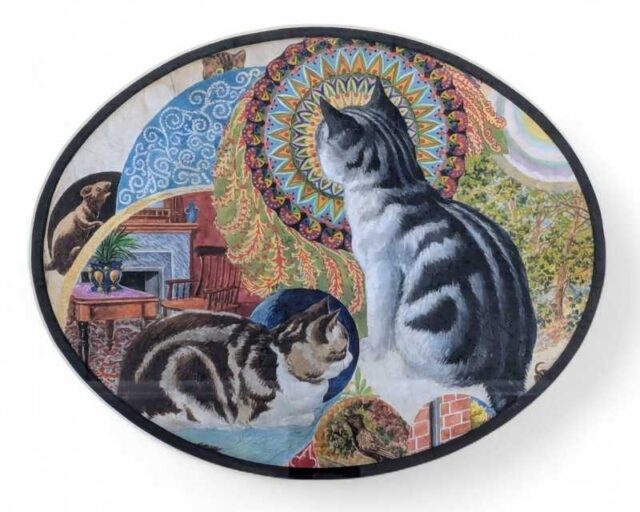
£3,000-5,000
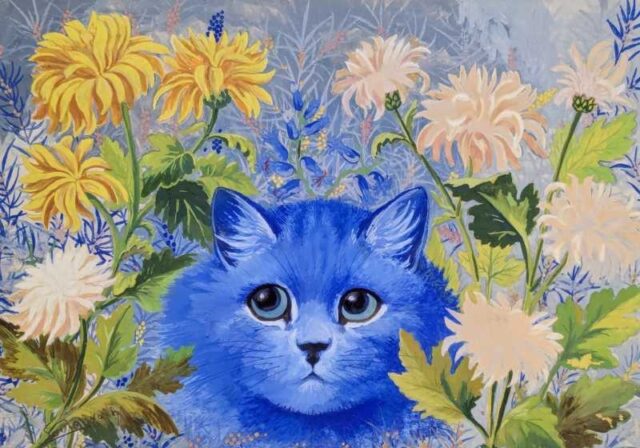
The British & European Fine Art auction takes place on Thursday 21st May at our Cardiff saleroom.
FAQs About Louis Wain Art
Why is Louis Wain's art so collectable?
Louis Wain's art is highly collectable due to its instantly recognisable cat imagery, cultural significance and enduring popularity among collectors of British illustration and modern art.
What is Louis Wain famous for?
Louis Wain is best known for his anthropomorphic cat paintings and illustrations, which became hugely popular during the Victorian and Edwardian periods.
Are Louis Wain's paintings valuable?
Original Louis Wain artworks regularly achieve strong prices at auction, particularly rare watercolours and late-period psychedelic cat paintings.
Where can I buy Louis Wain art at auction?
Collectors can buy Louis Wain art through specialist British art auctions such as Rogers Jones British & European Fine Art sales.


Ben Rogers Jones BA (Anrh)
HYNAFOLION A CHELF GYMREIG & ARBENIGWR HEN BETHAU’R BYD CHWARAEON