
World of Groggs at Auction: Rare Groggs for Sale and What They're Worth
Updated
In Summary:
- Groggs are hand-made clay caricatures, made by John Hughes in Treforest, near Pontypridd, from 1965 and continued by his son Richard Hughes.
- Limited editions such as Groggmore (2010) and Captain's Climb to Kilimanjaro are estimated at £500–800 each in our Groggs Galore timed sale, which ends Sunday 25 October 2026 at 8pm.
- Early John Hughes figures signed by the player can attract strong competition, even for club-level sitters.
- To date a Grogg, start with the base: the maker's signature ("John Hughes Wales" or "Richard Hughes Wales"), the year, and any edition number.
"There is no greater tribute than being immortalized in clay by the Hughes dynasty of Pontypridd."
For Welsh rugby fans, a Grogg is more than a figurine. It is a small, slightly irreverent piece of the game's history, made by hand in a former pub in Treforest. This guide covers where Groggs come from, how to identify and date them, what they sell for at auction, and how to buy or sell them through Rogers Jones.
What are Groggs?
Groggs are hand-sculpted, hand-painted clay caricatures, best known for their portraits of Welsh rugby players. They take their name from the type of clay John Hughes first used. Each figure exaggerates its subject's most recognisable features, which is a large part of their appeal to fans and to the players themselves.
Alongside rugby legends, the range includes other famous Welsh figures, Welsh dragons, animals, and characters from the Mabinogion. The tradition established from the start was that the first Grogg of each new character went to the person it depicted.
Who made World of Groggs?
John Hughes (1935–2013) began hand-sculpting and painting figures in 1965, in a garden shed behind his home in Treforest, near Pontypridd. His early subjects were characters from the Mabinogion, the Old Testament, and animals.
A passionate rugby fan, Hughes soon turned to caricatures of Welsh sporting heroes. His first were Gareth Edwards and JPR Williams. As Welsh rugby's golden era of the 1970s took hold, Groggs became popular with fans and players alike.
In 1971 the Hughes family bought the derelict Dan-y-Graig pub in Treforest. After extensive renovation, it became the Groggshop gallery and studio, home of World of Groggs. John's son, Richard Hughes, later joined the business and widened the range to other famous Welsh figures. Richard's work includes numbered limited editions such as Groggmore and Captain's Climb to Kilimanjaro, both offered in our October 2026 sale.
How do you date and identify a Grogg?
Turn it over. Most Groggs are signed and dated underneath or on the base, and that inscription tells you who made it and when.
| What to look for | What it tells you | Example from our October 2026 sale |
|---|---|---|
| "John Hughes Wales" plus a year | Made by the founder himself | Mark Jones of Neath, signed "John Hughes Wales 1990" |
| "Richard Hughes Wales" plus a year | Made by Richard Hughes | Groggmore, signed "Richard Hughes Wales 2010" |
| An edition number, such as 3/45 | A numbered limited edition | Groggmore and Kilimanjaro, both 3/45 |
| A certificate of authenticity | Supports a limited edition's attribution and number | Supplied with Groggmore and Kilimanjaro |
| The sitter's own signature | The player signed the figure | Mark Jones of Neath, signed by Mark Jones |
| Inscriptions to the base or rear | The occasion it marks | "WRU Cup Winners 1989-1990" on Mark Jones |
Condition matters too. Clay chips easily and paint can rub off, so look closely at the fingers, noses and boots of the figures. Check for restoration before you bid, and ask for a condition report if you can't view in person.
What makes one Grogg more valuable than another? Auctioneer Ben Rogers Jones outlines the five factors he considers when assessing a figure for auction: "In this order (1) quality and character (2) size (3) rarity (4) signed by player? (5) period = ie. John or Richard Hughes".
Rare Groggs for sale: Groggs Galore, October 2026
Our Groggs Galore timed auction closes on Sunday 25 October 2026 from 8pm. Every lot below comes from a single private collection in Blaenau Gwent. Lots are held at our Cardiff saleroom and can be viewed by appointment.
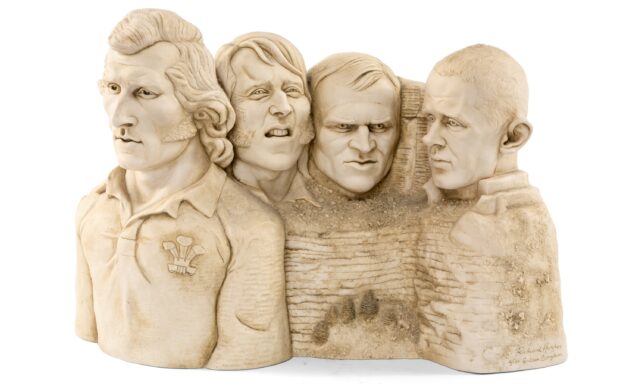
Groggmore (2010), limited edition 3/45 - Lot 118
Released to mark the shop's 45th anniversary, Groggmore reimagines Mount Rushmore with four Welsh rugby greats carved into the rock: Neil Jenkins, Gareth Edwards, Shane Williams and JPR Williams. Richard Hughes also used it to honour Bill McLaren, who died in 2010, inscribing commentary by McLaren on the reverse.
Groggmore (2010), limited edition 3/45 - Lot 118
Signed "Richard Hughes Wales 2010 Limited Edition 3/45". Approximately 23cm high and 35.5cm wide, with certificate of authenticity.
£500-800
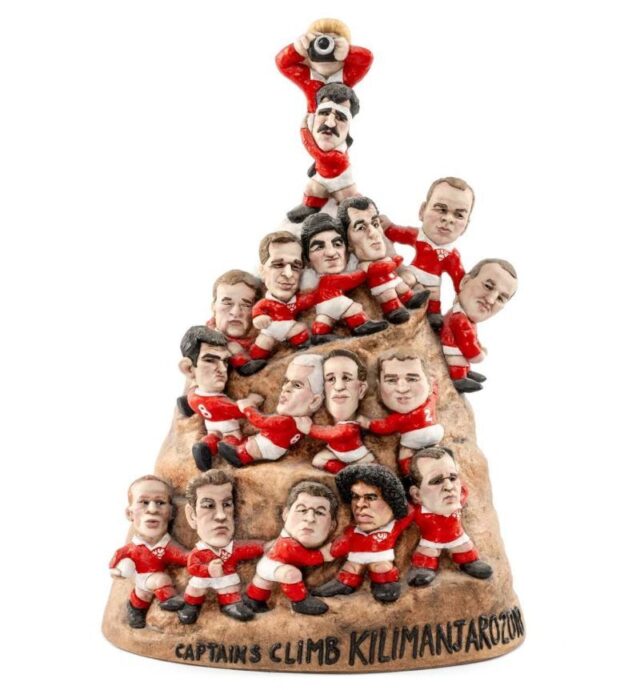
Captain's Climb to Kilimanjaro, limited edition 3/45 – Lot 151
This sculpture records the charity climb of Kilimanjaro by former Wales captains. The climbers include Gareth Thomas, Colin Charvis, Scott Quinnell, Rob Howley, Scott Gibbs, Ieuan Evans and Bob Norster, with Warren Gatland among them. Photographer Huw Evans sits at the summit with his camera, and a leopard nods to Ernest Hemingway's The Snows of Kilimanjaro.
Captain's Climb to Kilimanjaro, limited edition 3/45 – Lot 151
Signed underneath "Richard Hughes Wales 2011" and marked limited edition 3/45. Approximately 28cm high, with original certificate of authenticity.
£500-800
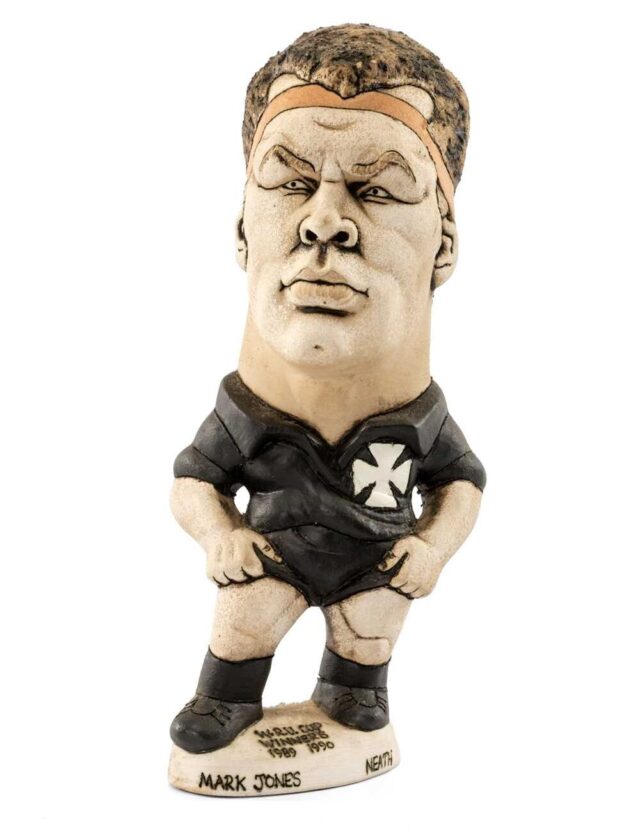
Mark Jones of Neath (1990) – Lot 155
An early John Hughes Grogg of Neath's Mark Jones in the black club jersey, No. 8 on the back. The base is inscribed "WRU Cup Winners 1989-1990 Mark Jones Neath".
This Grogg has already attracted bidding well beyond its original estimate. Auctioneer Ben Rogers Jones explains what makes this particular figure so rare:
"Rare model as Mark Jones moved to professional Rugby League after his promising union playing-career was just taking shape - he left for League after only 15 international union caps. Due to the poor perception of Welsh players' exodus to League in the 1980s, players were vilified and so not many Grogg models of Mark were made. Sadly Mark Jones died in 2025 at the age of 59. So, the Grogg is rare and is poignant."
Mark Jones of Neath (1990) – Lot 155
Signed underneath "John Hughes Wales 1990" and also signed by Mark Jones himself. Hollow, approximately 23cm high.
£80-120
Browse the full Groggs Galore catalogue. Bidding through Rogers Jones Live is free.
What are Groggs worth?
Our recent estimates run from £80–120 for individual player figures to £500–800 for numbered limited editions. The table below records our own estimates and hammer prices, newest first. Hammer prices exclude buyer's premium.
| Sale date | Lot | Grogg | Maker and date | Estimate | Hammer Price |
|---|---|---|---|---|---|
| October 2026 | 155 | Mark Jones of Neath, signed by the sitter | John Hughes, 1990 | £80-120 | £850 |
| October 2026 | 151 | Captain's Climb to Kilimanjaro, LE 3/45 | Richard Hughes, 2011 | £500-800 | £1,900 |
| October 2026 | 118 | Groggmore, LE 3/45 | Richard Hughes, 2010 | £500-800 | £1,300 |
| March 2025 | 15 | Unique WRU Double Centenary Grogg | John Hughes | £400-600 | £800 |
| March 2025 | 13 | The Pontypool Front Row Grogg | John Hughes, 1990 | £120-180 | £180 |
| March 2025 | 1 | Two Gareth Edwards caricatures | John Hughes, 1996 | £80-120 | £140 |
Buying secondhand Groggs at auction
Auction is the main route to secondhand Groggs that are no longer made, including early John Hughes pieces and sold-out limited editions. Here is how buying with Rogers Jones works.
- Register on Rogers Jones Live. Bidding there is free; bidding through the-saleroom.com carries a surcharge. A debit card is needed for registration and security only.
- View or request a condition report. Viewing is by appointment; email info@rogersjones.co.uk or call 01492 532176. Condition reports: lotenquirysw@rogersjones.co.uk.
- Bid. Timed sales let you leave a maximum bid and watch the lot until it closes.
- Pay and collect. Buyer's premium is 30% including VAT. Payment is by bank transfer within three working days. Collect from Cardiff by appointment, or arrange insured delivery.
Selling your Groggs
We hold dedicated Grogg and rugby memorabilia sales, and include Groggs in our Club House auctions. If you have a single figure or a whole collection, our specialists will give you a free, no-obligation auction valuation.
To help us value your Grogg, send a photograph of the front and of the signature underneath, and mention any certificate or edition number. Request a free valuation.
Explore more Welsh rugby collectables on our rugby antiques and memorabilia page.
Frequently asked questions
Where can I buy secondhand Groggs?
At auction. Rogers Jones offers Groggs in dedicated timed sales and in our Club House auctions, with lots held at our Cardiff saleroom. Registration and online bidding through Rogers Jones Live are free.
How much are Groggs worth?
It depends on the maker, the date, the subject and whether it is a numbered limited edition. In our October 2026 sale, estimates ranged from £80–120 for an individual signed player figure to £500–800 for limited editions of 45.
How can I tell if my Grogg was made by John Hughes or Richard Hughes?
Check the signature underneath or on the base. Figures by the founder are signed "John Hughes Wales", usually with a year; later work is signed "Richard Hughes Wales".
Why are they called Groggs?
The name comes from the type of clay John Hughes originally used to make the figures.
Who were the first rugby Groggs?
John Hughes's first rugby caricatures were of Gareth Edwards and JPR Williams.
Can Rogers Jones value my Groggs?
Yes. We offer free, no-obligation auction valuations for single Groggs and whole collections. Send photographs of the figure and its signature to our valuers.
Imminent Auctions
Thu 5 November 2026 10:00 AM
The Club House
Motor Sports | Rugby Union & League | Football | Medals & Militaria | Guinness | Maritime & Aeronautical | Railway
Cardiff Saleroom
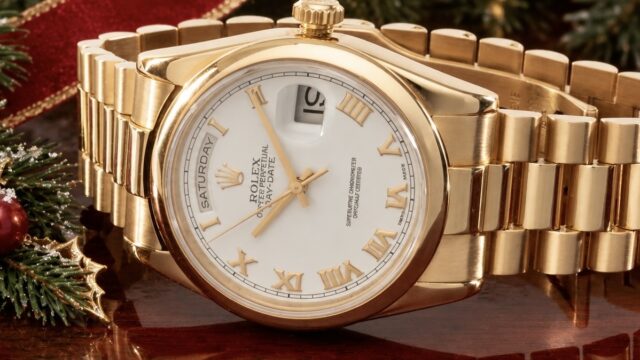
Thu 12 November 2026 10:00 AM
Luxury Gifts, Jewellery, Coins & Watches
Beautiful items consigned via our five hubs to the specialist pre-Christmas auction
Chester Saleroom
Tue 17 November 2026 10:00 AM
Colwyn Bay Monthly
Guitars | Furniture | Silver | Coins, Medals & Banknotes | Ceramics | Fine Art | Antiques & Collectables
Colwyn Bay