
Gwen John at a Hundred and Fifty
We can never know what prompted Augustus John to state so quotably that “Fifty years after my death, I shall be remembered as Gwen John’s brother.” Whether guided by a sense of sibling solidarity or bitter unease that his own career had not unfolded quite as he might have wished, his words register as being one of the most accurate self-fulfilling prophecies in modern art history.
Since Augustus’s death in 1961, Gwen John’s reputation has gathered momentum to the extent that, on the hundred and fiftieth anniversary of her birth, it can (and indeed has been) argued that she is perhaps the most famous artist ever born in Wales. The current major exhibition of her work at the National Museum in Cardiff further confirms that Gwen is here to stay.
In 1952, thirteen years after her death, Gwen John was mentioned in John Rothenstein’s Modern English Painters. Although praised for the focus and sureness of her work, her aims are described as “simple”: the kind of faint praise that places her as an interesting but minor player within the art world.
From the 1970s and 80s however, feminist art historians saw in Gwen John an artist who had been unjustly sidelined by the patriarchy, ignored simply for being a woman. John’s talent and originality confirmed their argument, and she became an early and ideal subject for the ongoing re-evaluation of women’s art. As research continues, Gwen emerges in all her complexity. By now she can be seen, not only as the timid spinster sister, but also as a single-minded free spirit, who defied Victorian convention by enrolling at the Slade School of Art, later establishing an independent life for herself in Paris. Then there is the fascinating contrast between her uninhibited bisexuality and her devout asceticism. Throughout her life, she neglected her health and comfort, often going hungry to pay her models and sustain her art practice. Just as she herself remains enigmatic, a tangle of contradictions, so her work and vision come into sharper focus, taking hold of our visual imagination and shaping our definition of what early twentieth century art looks like.
You suspect that none of this would have surprised Gwen John. Despite her reticence, her dislike of exhibiting and her ambivalence towards the art market, she always knew that her work was good - important, even. In a letter to her friend, Ursula Tyrwhitt, she wrote “I cannot imagine why my vision will have some value – and yet I know it will…” She goes on to describe her strategy for developing her gifts: the secret, she supposed, was rooted in patience and recueillé: a collectedness through which she could focus her full attention on art to the exclusion of all that would distract from her aims. From the start of her career, Gwen had seen how talent could be obliterated - through the domestic expectations that crushed the creative ambitions of her female contemporaries at the Slade - or dissipated through hype and hubris, as in the case of her own brother.
The strictness of her approach allowed no sweeping gestures or flashy brushwork. Her pictures, whether they be drawings, oils or watercolours, are relatively small, sometimes miniscule. She returns to the same subjects (women, children, cats, interiors, flowers, the occasional landscape and later, nuns and worshippers at Mass). She develops her work slowly, from picture to picture, through endless repetition, her refinements subtle, infinitesimal. She converted to Catholicism in 1913, and far from being a constraint this allowed her, through devotion and ritual, to seamlessly unite her work and her very existence. By this time, Gwen was referring to herself as “God’s little artist”, which sems an incongruously twee turn of phrase for her. Until you realise that she meant it quite literally: she was a physically small woman on an artistic mission from God.
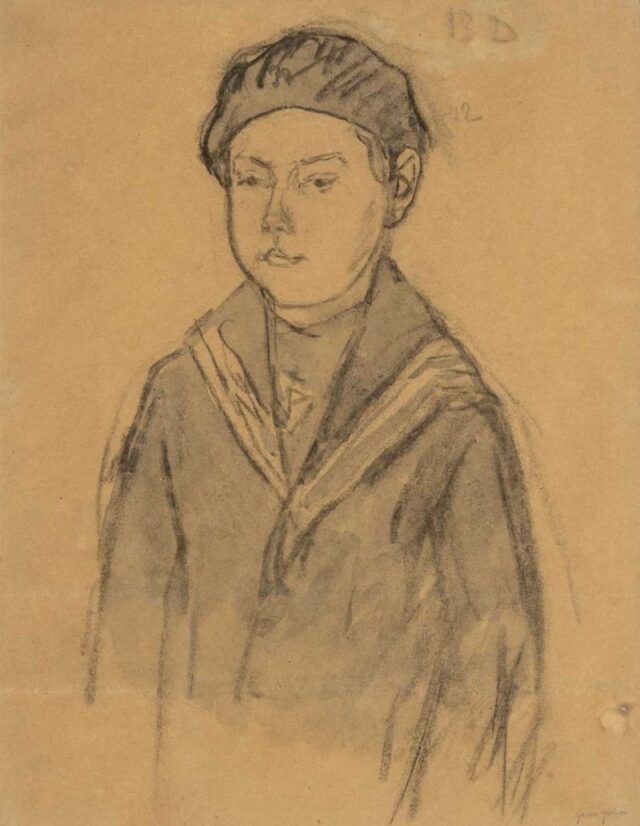
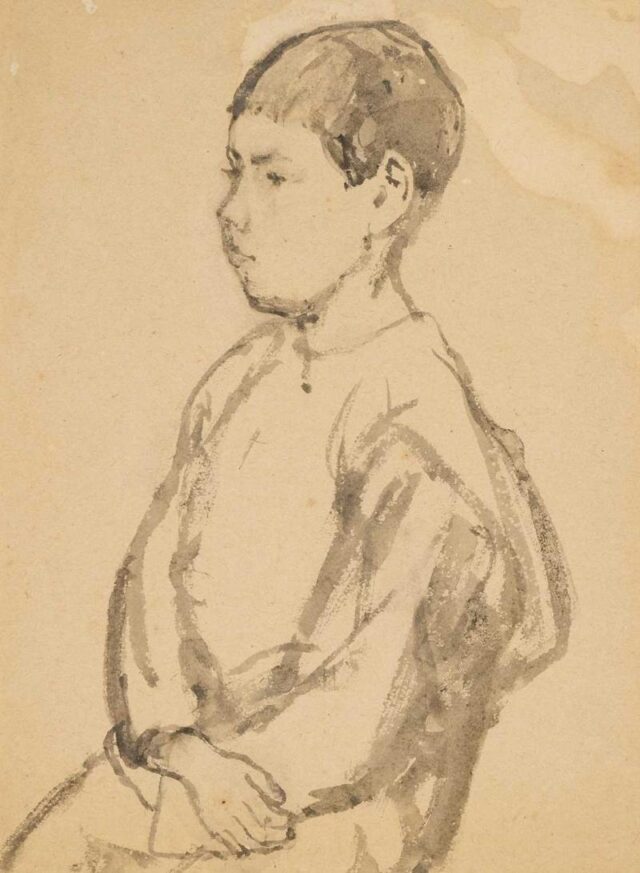
The three Gwen John drawings featured in this spring’s Welsh sale are, as one would expect of an artist who reveals through repetition, entirely typical of her work. Two young boys, frozen under her scrutiny, caught between tension and reverie as they sit rigidly, thinking how to spend the few centimes they will earn once Mademoiselle sets her brush or pencil aside.
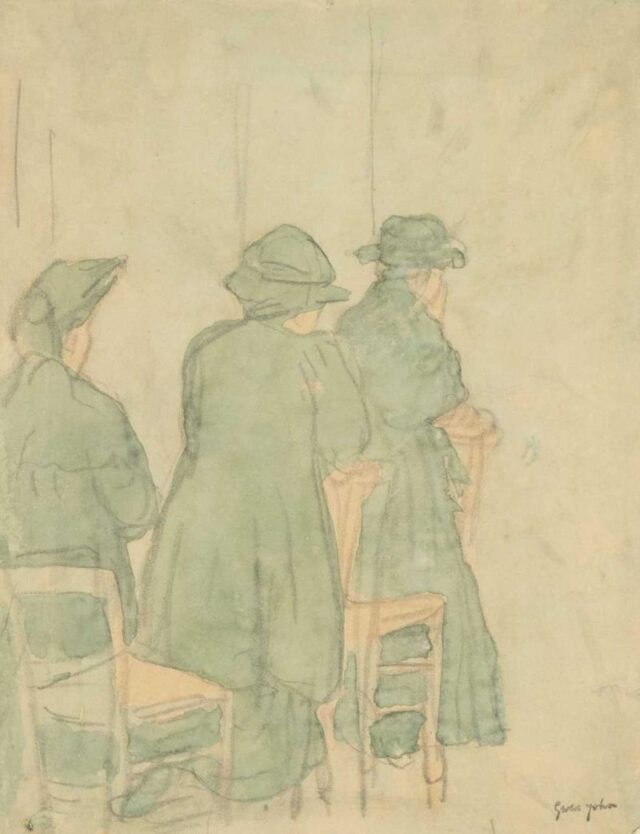
A sketch of three fellow parishioners in church, seen from behind, each abstracted within their familiar ritual. Gwen always draws worshippers from behind; she seems to have been more comfortable at the back of the building - in the sinners’ seats or “sêt pechaduriad” as we say in Welsh. Perhaps she sat there out of humility, or perhaps to avoid the irritable attention of the priest, who could not have known that to her drawing was akin to worship.
Every scrap of art that Gwen John produced is part of a longer paper trail which charts her conscious development and scrupulous denial of all that would undermine her very particular aims. Within her work the roar of history is absent, as are the lesser expectations that would soon become obsolete - who she should be, for instance, and particularly what kind of art she should aspire to create. A century and a half since her birth, it seems obvious, in a world wary of the equivocal promises of AI and frayed by the demands of social media, that her work should resonate as it does. From the perspective of 2026, or any other year, the art that arose from her lifetime of intense focus is astounding, relevant and arguably essential.
By Ruth Richards
Ruth Richards is an author and art historian. Her doctoral study on the work of the Welsh photographer John Thomas was published last year. (Golwg Ehangach: Ffotograffau John Thomas o Gymru Oes Fictoria, University of Wales Press, 2024).
The April 19th Welsh Sale (Part I) catalogue is available to view online here.
Viewing can be arranged at our Cardiff auction house by appointment by calling us on 02920 708125. There will be an open viewing on Saturday 18th April from 10am-2pm.
Imminent Auctions

Ends: Sun 25 October 2026 8:00 PM
Groggs Galore: Timed Auction
Rare finds, familiar faces & collectables with character!
Cardiff Saleroom

Tue 27 October 2026 10:00 AM
Chester Monthly
Contemporary, Mid-Century & Antique Furniture & Furnishings | Jewellery, Coins & Watches | Pictures
Chester Saleroom

Thu 5 November 2026 10:00 AM
The Club House
Formula 1 | Rugby Union | Welsh Football incl. Ryan Giggs Match Worn | Medals & Militaria | Groggs ETC
Cardiff Saleroom